
Explore the applications of nutraceuticals in managing feline inflammatory bowel disease (IBD). Learn how these adjunctive therapies support gut health, reduce inflammation, and complement conventional treatment protocols for improved patient outcomes.
Inflammatory bowel disease (IBD) in feline patients presents a diagnostic and therapeutic challenge, with multifactorial pathogenesis and variable clinical presentations that complicate case management. Along with conventional therapies, many practitioners are exploring adjunctive approaches to improve outcomes and reduce adverse effects. Nutraceuticals, with their anti-inflammatory, immunomodulatory, and gut-supportive properties, represent a practical tool in the multimodal management of feline IBD.
Understanding inflammatory bowel disease (IBD)
Inflammatory bowel disease can affect all manner of species, including dogs, cats, and humans. Often, our feline patients appear to be overrepresented. IBD can be quite challenging to understand. On the surface, the disease process seems simple and straightforward; however, the exact etiology is still being studied.1 First, one must understand that the pathogenesis of this disorder is often thought to be multifactorial. Second, IBD is more of a syndrome than a specific disease. It often results from chronic irritation of the intestinal tract. Inflammatory cellular infiltrates accumulate within the lamina propria of the intestinal tract, causing the lining of the GI tract to thicken.3 The chronic inflammation and thickening results in a reduced ability to absorb nutrients and move digesta along the GI tract. Clinical signs in cats can vary and may include vomiting, weight loss, diarrhea, bloody stools, lethargy, and decreased appetite.3 The degree and severity of these signs will depend on which part of the GI tract is affected.
Diagnosing IBD can also be challenging
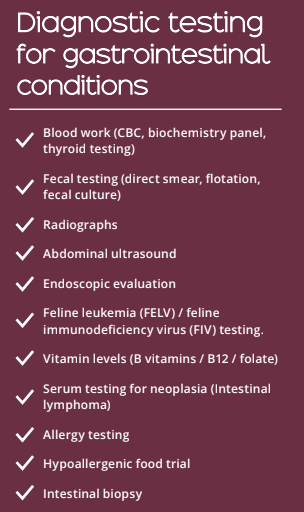
Many of the clinical signs noted on presentation are symptoms seen with other disorders affecting the GI tract.3 This can make it difficult for practitioners to accurately diagnose IBD with clinical presentation alone. Diagnostic testing is required to guide the diagnosis and rule out other gastrointestinal disorders. The sidebar on page xx lists some of the more common diagnostic tests that can be used. However, for a definitive diagnosis of IBD, gastric or intestinal biopsies are required.3
When considering IBD from a Traditional Chinese Veterinary Medicine (TCVM) perspective, one must include the organ systems of the Spleen (SP), Stomach (ST), Small Intestine (SI) and Large Intestine (LI).4 The Liver (LIV) can sometimes be involved along with a varying and intricate combination of excesses and deficiencies of Qi, Yin, Yang, Blood, Jing and the pathogenic factors of Damp, Heat, Cold and Phlegm.4 The most common TCVM Patterns recorded in cases of canine IBD are Liver Qi Stagnation, Damp-Heat and/or Heat-Toxin, Qi-Blood Stagnation and Spleen Qi Deficiency.4
Treating inflammatory bowel disease
Inflammatory bowel disease can be as difficult to treat as to diagnose. Again, this can be attributed to the specific location of pathology along the GI tract, and the variety of clinical signs demonstrated.
- Conventional treatment options may include multiple therapies and are often used in combination. They can include protocols for broad spectrum deworming, antibiotics tailored for the GI tract, anti-inflammatories such as steroids, vitamin B12 supplementation, and specialized diets.
- Holistic treatment options that can be utilized for IBD include therapeutic laser therapy, acupuncture, Chinese and Western herbal medicine, Chinese food therapy along with other specific natural and species-specific dietary therapies, homeopathy, essential oil therapy, and vitamins and supplements.6 Nutraceuticals are also a good choice and can play a major role in treating IBD.
The role of nutraceuticals in treating IBD
From a completely clinical “black and white” perspective, nutraceuticals are defined by the literature and the Merriam-Webster Dictionary as “a foodstuff (such as a fortified food or dietary supplement) that provides health benefits in addition to its basic nutritional value”.7 Another way to understand what nutraceuticals are is to think of them as “specially designed preparations,” formulated with the aim of fulfilling specific dietary requirements and/or offering preventive health care.8 In other words, taken from the literature, nutraceuticals involve the formulation of nutrients to help prevent and treat some diseases, in addition to a supplemented diet.
The term “nutraceutical” was coined by Dr. Stephen De Felice in 1989.8 It comes from two words: “nutrition” and “pharmaceutical.” Dr. De Felice used the term as a way to define products that were neither completely nutrients nor pharmaceuticals, but that provided health benefits.8
Since that time, nutraceuticals have become popular within the mainstream. This popularity, which originated with human medicine, has also transitioned into the veterinary world. In one article published in 2020, it was reported that an estimated 10% to 33% of cats and dogs and up to 84% of horses in the US were fed a pet supplement or nutraceutical.9
Categories of nutraceuticals in veterinary medicine include dietary supplements, functional foods, medicinal foods, and farmaceuticals:2,10
Dietary supplementation with nutraceuticals provides essential nutrients to support overall health.10
Nutraceuticals used as functional foods enhance specific functions, such as digestion or immune response.10
Treating specific health conditions can be achieved with nutraceuticals used as medicinal food.10
Nutraceuticals used in agricultural contexts are considered farmaceuticals.10
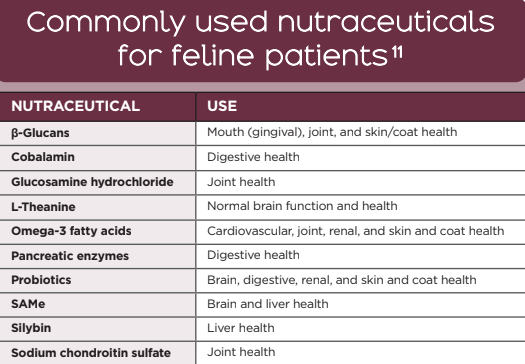
Not only can nutraceuticals be organized into the above four categories, but they can also be subcategorized into the body systems they support. Nutraceuticals are known to help the brain, digestive system, mouth and gums, cardiovascular system, immune system, musculoskeletal system, hepatic system, renal system, and of course the skin and coat.11 Of these, most veterinarians are familiar with nutraceuticals for skin, joint, and digestive health.2,11 Omega -3 fatty acids, glucosamine and chondroitin, SAMe, silybin, and probiotics are some of the most commonly prescribed nutraceuticals.2 The table on page xx outlines some of the more common nutraceuticals used in feline patients.
Treating feline IBD with nutraceuticals
As previously discussed, IBD can be challenging to treat in any species, but this is more evident in our feline patients. Cats present a unique set of challenges not often seen in other species. As most owners and veterinarians can attest, cats are not always the easiest to administer medications and supplements to. This can create unique challenges and creative thinking for those who must give anything to a cat.
Another important consideration when developing a treatment plan for cats stems from the evolutionary development of the feline species. With the cat’s lack of a Cp450 enzyme system, and reliance on different enzymatic pathways for breaking down and detoxifying substances, care must be taken when utilizing specific medications and supplements.12,13,14
Multiple nutraceuticals can be used to treat IBD in cats. However, when focusing on feline IBD it is important to remember that, at its base, this condition is a form of chronic inflammation that leads to dysbiosis of the GI tract. Choosing appropriate nutraceuticals for targeting the underlying inflammation is critical to long term management. Managing dysbiosis is equally important and can help improve digestive issues. Often, this can be achieved with appropriate probiotics and vitamins.
Some of the most common nutraceuticals for treating IBD in cats include turmeric, probiotics, digestive enzymes, Omega-3 fatty acids, vitamins, and herbal therapy.15
- Turmeric: In both human and animal medicine, turmeric is widely known for its powerful anti-inflammatory effects, arising from its primary active ingredient, curcumin, an active polyphenol.16 It is a highly pleiotropic molecule with the potential to modulate the biological activity of a number of signaling molecules.16
- Probiotics: Due to the dysbiosis caused by the chronic inflammation of IBD, the intestinal microbial landscape is turned upside down. The normal gut biome provides barrier-protective functions along with nutritional, metabolic, and immunological functions.17 Probiotics are a mainstay for restoring normal bacterial flora and gut function.5 When choosing probiotics, products with multiple strains of beneficial bacteria and large numbers of colony forming units (CFUs) are often preferred. Some of the most common bacterial isolates include Lactobacillus acidophilus, Bifidobacterium animalis and Enterococcus faecium.5,15
- Omega-3 fatty acids: These natural anti-inflammatory compounds exert their effects by decreasing the generation of leukotrienes.5 One example is the leukotriene LTB4, a potent neutrophil chemotactant and pro-inflammatory molecule.5 Omega-3 fatty acids also prevent cytokine-induced intestinal permeability defects.5 Incorporated into a treatment plant for IBD, Omega-3 fatty can help reduce inflammation and alleviate symptoms of diarrhea, vomiting, and weight loss.
- Vitamins: An integral part of the normal physiological process, vitamins aid nutrient absorption and proper GI function. For example, research has shown that cats with GI dysfunction and diseases such as IBD have a lower-than-normal level of serum cobalamin (vitamin B12).5 Low levels of cobalamin have been linked to impaired enterocyte function.5 This can contribute to ongoing malabsorption and clinical signs. Vitamin B12 is best supplemented by injection for better absorption and bioavailability.5,18 Supplementation often leads to weight gain, increased appetite, and decreased vomiting and diarrhea over time.
- Herbal therapy: Many herbal therapies have been used successfully for treating GI conditions. They include principles from Chinese and Western herbal medicine, and Ayurvedic medicine. Bitter herbs are often used to help treat GI conditions, including IBD.19 They help eliminate Heat and Damp and purge the intestines.19 Bitter herbs have been shown to have anti-inflammatory, anti-pyretic, detoxifying, anti-viral, and anti-parasitic effects.19 Specific herbs and spices that have been used for GI conditions include fennel, ginger, black pepper, clove, cinnamon, coriander, and peppermint. These have been demonstrated to relieve gas and pain.15
Berberine herbs have been known to play a significant role in regulating metabolism.15 Two other herbals noted for helping with IBD in cats include slippery elm and licorice root. Slippery elm has soothing properties and can help coat and protect the intestinal lining, reducing inflammation.20,21 Licorice root is a very potent natural anti-inflammatory.21 It can be used as a natural alternative to steroids. While safe, care should be taken with long term use by monitoring liver and kidney functions.
Other considerations and treatments for feline IBD
Many holistic techniques and medical systems have originated from the cultural beliefs of specific regions around the globe. While their teachings may be different, they all share one common goal: to provide help and heal the body.
In Chinese medicine, for example, an accurate diagnosis and treatment plan is developed through pattern diagnosis, achieved through an extensive history and TCVM exam. Recognized TCVM patterns for IBD include Heat Toxin/Damp Heat, Liver Qi Stagnation, Damp Heat with Spleen Qi Deficiency, and Spleen Qi Deficiency.4,22 From a Chinese medicine standpoint, once the correct pattern is diagnosed the proper acupuncture prescription, herbal remedy, or food therapy can be utilized.
Another treatment modality for managing IBD is laser therapy.23 Once laser light is emitted from the device, it travels through the tissues of the body, where the photons are absorbed by the chromophores and interact with the cytochrome C complex within the mitochondria of the cell.24,25 This stimulates a variety of biological processes that transform light energy into biochemical energy. The resulting response helps reduce inflammation, decrease pain, and increase healing.
Final thoughts
IBD can be very challenging to treat in most species, but this can be especially true for our feline patients. Their evolutionary physiological developmental differences, coupled with their aloofness, can create stressful treatment situations for any veterinarian or owner. So, it is important to consider less stressful approaches when trying to formulate a treatment plan. Nutraceuticals are an effective and easy alternative.
References
1. Dowling PM, Foster D, Abuelo A. Drugs Used to Treat Inflammatory Bowel Disease in Monogastric Animals. Merck Veterinary Manual Online Edition. Reviewed/Revised May 2023 | Modified Jun 2025. https://www.merckvetmanual.com/pharmacology/systemic-pharmacotherapeutics-of-the-digestive-system/drugs-used-to-treat-inflammatory-bowel-disease-in-monogastric-animals?query=inflammatory%20bowel%20disease%20in%20cats. Last accessed 8/1/2025.
2. Weir M, Llera R, Williams K, Ward E. Inflammatory Bowel Disease in Cats. https://vcahospitals.com/know-your-pet/inflammatory-bowel-disease-in-cats. Last accessed 8/1/2025.
3. Inflammatory Bowel Disease. CornellUniversity College of Veterinary Medicine. https://www.vet.cornell.edu/departments-centers-and-institutes/cornell-feline-health-center/health-information/feline-health-topics/inflammatory-bowel-disease. Last accessed 8/1/2025.
4.Chan M. Efficacy of Chinese herbal medicine for the rescue treatment of refractory or intermittent idiopathic inflammatory bowel disease in canine patients: A retrospective study. Am J Trad Chin Vet Med 2019; 14(1):21-3.
5.Trepanier L. Idiopathic inflammatory bowel disease in cats. Rational treatment selection. J Feline Med Surg. 2009 Jan;11(1):32-8. doi: 10.1016/j.jfms.2008.11.011. PMID: 19154973; PMCID: PMC11135483.
6. Krause A. IBD in cats – an integrative approach to treatment. Animal Wellness Magazine. February 28, 2022. https://animalwellnessmagazine.com/ibd-cats-integrative-treatment/. Last accessed 8/1/2025.
7. Nutraceutical. Merriam-Webster Dictionary. https://www.merriam-webster.com/dictionary/nutraceutical. Last accessed on 8/1/2025.
8. Puri V, Nagpal M, Singh I, Singh M, Dhingra GA, Huanbutta K, Dheer D, Sharma A, Sangnim T. A Comprehensive Review on Nutraceuticals: Therapy Support and Formulation Challenges. Nutrients. 2022 Nov 3;14(21):4637. doi: 10.3390/nu14214637. PMID: 36364899; PMCID: PMC9654660.
9. Finno CJ. Veterinary Pet Supplements and Nutraceuticals. . 2020 Mar-Apr;55(2):97-101. doi: 10.1097/nt.0000000000000399. PMID: 33446942; PMCID: PMC7802882.
10. What is Nutraceuticals for Animal Pets. https://rehabvet.com/nutraceuticals/what-is-nutraceuticals/. Last accessed on 8/1/2025.
11. Kruzer A. Integrating Veterinary Supplements and Nutraceuticals Into Traditional Approaches. Today’s Veterinary Nurse. August 30, 2024. Fall 2024. Volume 7, Number 4. pp. 42-46.
12. Sugiyama S, Uno Y, Amano T, Kitazawa T, Teraoka H. Genetic diversity of cytochrome P450 3A with different metabolic activity in domestic cats. J Vet Med Sci. 2019 Apr 16;81(4):598-600. doi: 10.1292/jvms.18-0692. Epub 2019 Mar 4. PMID: 30828039; PMCID: PMC6483910.
13. Visser M, Weber KL, Lyons LA, Rincon G, Boothe DM, Merritt DA. Identification and quantification of domestic feline cytochrome P450 transcriptome across multiple tissues. J Vet Pharmacol Ther. 2019 Jan;42(1):7-15. doi: 10.1111/jvp.12708. Epub 2018 Aug 31. PMID: 30171610; PMCID: PMC6322962.
14. Antonovic L, Martinez M. Role of the cytochrome P450 enzyme system in veterinary pharmacokinetics: where are we now? Where are we going? Future Med Chem. 2011 May;3(7):855-79. doi: 10.4155/fmc.11.37. PMID: 21644832.
15. Natural Treatment Options For Cats With IBD. https://petshun.com/article/cat-ibd-natural-treatment. Last accessed 8/1/2025.
16. Gupta SC, Kismali G, Aggarwal BB. Curcumin, a component of turmeric: from farm to pharmacy. Biofactors. 2013 Jan-Feb;39(1):2-13. doi: 10.1002/biof.1079. Epub 2013 Jan 22. PMID: 23339055.
17. Yang Q, Wu Z. Gut Probiotics and Health of Dogs and Cats: Benefits, Applications, and Underlying Mechanisms. Microorganisms. 2023 Sep 29;11(10):2452. doi: 10.3390/microorganisms11102452. PMID: 37894110; PMCID: PMC10609632.
18. Siani G, Mercaldo B, Alterisio MC, Di Loria A. Vitamin B12 in cats: nutrition, metabolism, and disease. Animals. 2023 Apr 26;13(9):1474.
19. Xie H, Preast V. Introduction to Chinese Herbal Medicine. In: Xie’s Chinese Veterinary Herbology. Wiley-Blackwell. Ames, Iowa. 2010. pp. 5-15.
20. Slippery Elm. https://epi4dogs.com/slippery-elm/. Last accessed on 8/1/2025.
21. Berschneider HM. Complementary and alternative veterinary medicne and gastrointestinal disease. Clinical techniques in small animal practice. 2002 Feb 1;17(1):19-24.
22. Ma A. Inflammatory Bowel Disease. Chapter 1: Quick Selection of Herbs Based on Clinical Conditions: Gastrointestinal Disorders. In: Clinical Manual of Chinese Herbal Medicine, 5th ed. Ancient Art Press. Gainesville, FL. 2020. Page 15.
23. Lavallee J, Olson J. Chapter 19: Feline Specific Conditions. In: Laser Therapy in Veterinary Medicine. Wiley, Blackwell. Ames, Iowa. 2017. pp. 203-204.
24. Hashmi JT, Huang YY, Osmani BZ, Sharma SK, Naeser MA, Hamblin MR. Role of low-level laser therapy in neurorehabilitation. PM R. 2010;2(12 Suppl 2):S292-S305. doi:10.1016/j.pmrj.2010.10.013.
25. Stephens B. Chapter 3: Laser Physics in Veterinary Medicine. In: Laser Therapy in Veterinary Medicine. Wiley, Blackwell. Ames, Iowa. 2017. pp. 19-28.