

A comprehensive look at cardiovascular diseases in dogs along with integrative treatment approaches combining Traditional East Asian Medicine (TEAM), acupuncture, herbs, nutrition, and other therapies to support heart health.
Cardiovascular disease is a significant health concern in dogs, particularly as they age, though it can also affect younger animals. As veterinary medicine evolves, so too do the approaches to managing these complex disorders. This article explores common cardiovascular conditions in canines and presents an integrative treatment framework that blends Traditional East Asian Medicine (TEAM), acupuncture, herbal remedies, nutrition, essential oils, and therapeutic modalities such as ozone and PEMF. By taking an integrative approach, we can support our canine patients’ heart health in a variety of ways.
Causes and incidence of cardiovascular disease in dogs
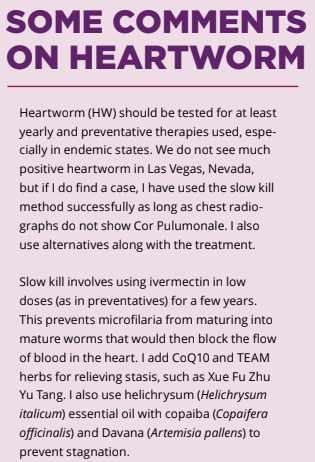
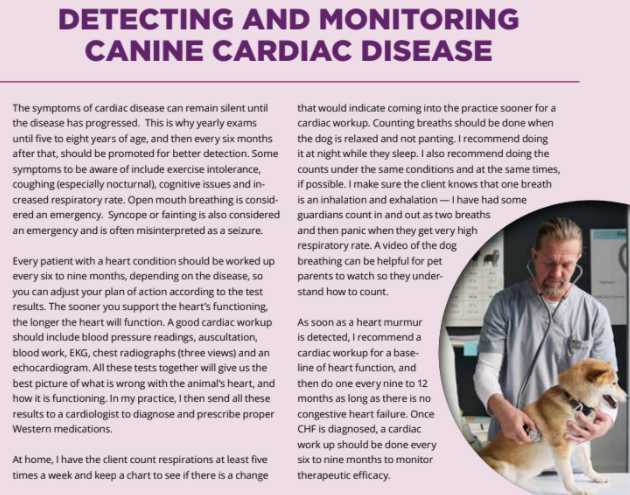
Cardiovascular disease seems to be more of a geriatric disease in dogs. However, some congenital diseases, like patent ductus arteriosis (PDA) or congenital murmurs, occur in younger animals. Infectious diseases such as heartworm disease and endocarditis can also affect the heart at any age. Cardiovascular disease can also arise from a pet’s lifestyle choices, with obesity, lack of exercise and poor nutrition playing big parts.
Congestive heart failure (CHF) is really not a disease as much as a sequela to long term stress on the heart, to the point where the heart can no longer compensate. Preventing CHF is the goal of maintaining a healthy heart.
Treatment for cardiac disease in dogs
After a cardiac workup is done (see sidebar on page xx), I follow the recommended pharmaceutical interventions if needed. If the workup shows the heart is functioning well in spite of a murmur or other disease, I will start an integrative approach first.
- The root of treatment should be nutritional. An appropriate evolutionary diet is recommended.1 Studies have appeared to show that grain free diets lead to cardiomyopathy, but it’s the use of pea protein as the protein source for carnivores that was found to be the problem. Adding grains back in didn’t solve it; the issue was the use of vegetable protein rather than animal protein for carnivores.2 Getting good quality digestible protein is best for the canine heart.
Nutrition overall should supply all vitamins, minerals, and a complete complement of amino acids and fatty acids. Maintaining good gut health with digestive enzymes, probiotics, and a balanced green food that is bioavailable and ferments is crucial to heart health so the tissues can repair and thrive. Eating a balanced diet that is properly digested and absorbed is vital for the heart health of all pets.1
- When the heart is compromised in some way, I add supplements for increased “food for the heart.” I find that CoQ10 in a liposomal form works the best; I have used CoQ10 from Rx Vitamins. I also use Cardio+ from Standard Process or Biocardio from Thorne as basic heart healthy supplements to keep the heart functioning, whether the dog has no disease or has CHF.3
- I use ozone therapy to support the heart tissue, increase oxygenation to the tissues, and increase ATP production (in Traditional East Asian Medicine terms, this tonifies the qi – more on this below). Rectal ozone at 1ml/# weekly is very helpful for keeping the heart muscle healthy and increasing oxygen delivery to all cells in the body. In TEAM terms, this is increasing heart qi.4
I also use IV therapy of ozone with UV light (UBI) to decrease the microbial load in the system and increase the antioxidant system. I will also use Meyer’s cocktail IV to help with the antioxidant system.5
PEMF is another modality I used for cardiac function. This helps the electromagnetic field of the heart and increases its regularity and circulation. I first started using PEMF for arthritis, then found that a poodle with CHF experienced an 80% improvement in heart function while receiving this treatment. It is very easy to place the pet in the ring or on the mat while we do ozone and IV therapies.6
- Lastly, I ensure healthy dental environments with an at-home essential oil proprietary blend7 in a chemical-free safe mouthwash. This decreases bacteria overgrowth and helps good bacteria in the gut. Thymol,8 an ingredient in some essential oils (and the main ingredient in Listerine), has been shown to kill bacteria in the mouth. I use the essential oil emulsified product as Listerine is full of chemicals and not safe to swallow. You want an emulsified product as non-diluted essential oils can be too strong for pets, and can even burn the mouth.
Another product I use, especially on smaller dogs with chronically infected gums, is cold plasma at least weekly on the gumline. Cold plasma is known to kill all microbes including MRSA.9 I use the combination of ozone and cold plasma in the clinic, plus the emulsified product at home, for pets that are not candidates for anesthesia and deep cleaning dentals. For dogs that can tolerate anesthesia, I recommend deep cleanings every one to years, depending on how the mouth is doing. If a dog is on evolutionary appropriate diets with good gut health, I often only have to do dental cleanings every five years.
Overall, the key to cardiac health is good nutrition and gut health, a clean mouth and balanced supplements.
Canine cardiac disease from a TEAM perspective
From a Traditional East Asian Medicine (TEAM) perspective, cardiac disease is deep and chronic and often indicates multiple systems in disharmony. “The Emperor is the heart and is protected by all other Zang Fu (organ systems)”; as such, a multimodal approach to heart health is recommended.
Different TEAM diagnosis considerations exist for heart disease. They are approached with different herbs and acupuncture protocols. You could be dealing with excess or deficiencies (xu), or a combination of both, leading to heart weakness.
Qi or blood stasis — regulate the qi and dispel blood stasis
Heart blood stasis
Symptoms: Palpitations, cyanosis, cold paws ears 4-finger cold, spontaneous sweating, possible respiratory issues or pawing at chest; this can also be true with mediastinal or heart base masses
Tongue: Purple
Pulse: Choppy
Treatment: Move blood, eliminate stasis, tonify and warm heart yang, calm shen
Acupuncture: PC6, PC4, HT5, REN17, UB14, UB17, SP10 KD25 with moxa
Herbs: Xue Fu Zhu Yu Tang (drive out the stasis in the mansion of blood decoction)
Essential oils: Helichrysum (Helichrysum italicum) or Palo Santo (Bursera gravedens)
Heart qi stagnation
Symptoms: Palpitations, depression, sighing, clearing throat a lot, shortness of breath, poor appetite, weak and cold libs 3-finger cold on the ears
Tongue: Pale purple
Pulse: Empty
Treatment: Move Heart qi, open the chest and calm the shen
Acupuncture: PC6, REN17, HT5, HT7, REN15, LU7, ST40, LI4
Herbs: Ban Xia Hou Po Tang (Pinellia Magnolia decoction)
Essential oils: Ylang Ylang (Cananga odorata), orange (Citrus sinensis) or cypress (Cupressus sempervirens)
Dampness — regulate the qi, dispel dampness and tonify the Spleen
Spleen qi xu and heart blood xu
Symptoms: Forgetfulness, palpitations, anxiety, insomnia, phobias, withdrawal, reduced appetite, may have bleeding syndromes
Tongue: Pale
Pulse: Thin and frail
Treatment: Tonify spleen qi and nourish heart blood
Acupuncture: HT7, PC6, REN14,15,4 UB17 (with moxa), UB20, REN12, ST36, SP6 (with moxa)
Herbs: Gui Pi Tang (Restore the Spleen decoction)
Essential oils: Ginger (Zingiber officinale), orange (Citrus sinensis), Davana (Artemisia pallens), proprietary essential oil blend for the emotion of joy,11 essential oil blends that help with digestion
Excess heat — drain heat
Heart fire or excess heat
Symptoms: Palpitations, excessive thirst, mouth and tongue ulcers, abnormal mental behaviors, insomnia, 4-finger hot on the ears, hot dark yellow urine or blood in the urine, panic, mitral valve in younger pets
Tongue: Red, especially tip
Pulse: Rapid and full
Treatment: Clear heart heat, drain fire and calm the shen
Acupuncture: HT9, HT8, HT7, REN15, SP6, KD6, LI11, DU24, DU19
Herbs: Xie Xin Tang (Drain the Heart decoction)
Essential oils: Peppermint (Mentha piperita), vetiver (Vetiveria zizanoides), vanilla (Vanilla planifolia), essential oil blends that help ground the pet
Qi/xue xu – tonify the qi and blood (xue) of both spleen and heart
Heart qi xu
Symptoms: Palpitations, shortness of breath on exertion, tiredness, listlessness, spontaneous sweating, mild depression and pale face Tongue: Pale
Pulse: Empty, weak and thready
Treatment: Tonify heart qi
Acupuncture: HT5, PC6, UB15, REN17, REN6, DU14
Herbs: Ding Xhi Wan (Settle the Emotions pill)
Essential oils: Orange (Citrus sinensis), eucalyptus globulus (Eucalyptus globulus leaf oil) proprietary essential oil for the emotion of joy11
Heart yang xu
Symptoms: More severe with cold
Treatment: Tonify and warm heart yang
Acupuncture: Same points with moxibustion (I use a tiger warmer over the points)
Heart blood xu
Symptoms: Palpitations, pale lips, dizziness, insomnia, vocalization at night, poor memory, anxiety, easily startled, vertigo
Tongue: Very pale, dry
Pulse: Choppy or fine
Treatment: Nourish blood, tonify heart and calm the shen
Acupuncture: HT7, REN14, REN15, REN 4, UB17, UB 20 (moxa on back points)
Herbs: Dang Gui Ji Xue Teng Tang (Tangkuei and Jixueteng decoction)
Essential oils: Orange (Citrus sinensis), ginger (Zingiber officinale), proprietary essential oil blend for the emotion of joy11
Heart yin xu
Symptoms: Similar to heart xue xu, only more severe and more dryness
Treatment: Nourish heart yin, calm the shen, clear empty heat
Acupuncture: HT7, REN 14,15,4 HT6, SP6 KD7
Herbs: Shen Qi Si Wu Tang (Ginsend-Astragalus Four Substance)
Essential oils: Ylang ylang (Cananga odorata), cobiaba (Copaifera officinalis), proprietary essential oil blend for the emotion of joy11
Heart and kidney not communicating — tonify heart and kidney and harmonize water and fire
Symptoms: pulse deficits, edema in rear legs, 4-finger hot on the ears, dry mouth, dizzy, insomnia, low back pain, restless especially at night
Treatment: Tonify heart and kidney yin and harmonize water and fire
Acupuncture: PC6 SP4, HT7,6,5 UB15, REN 15,4 DU24, KD3, KD10,9,6, SP6
Herbs: Tian Wang Bu xin Tang (Yellow Emperor Tonify Heart pill)
Essential oils: Frankincense (Boswellia carterii)
Shen disturbances or cognitive disorder — in TEAM terms, this is related to the heart so the plan of action should include nourishing the heart
Phlegm misting the heart (mind)
Symptoms: Mental conditions of confusion, severe behavior issues Tongue: Swollen and sticky
Pulse: Slippery
Treatment: Open heart, resolve phlegm, open the mind’s orifice
Acupuncture: HT9, PC5, UB15, ST40, DU26, REN12, UB20, DU14 (with fire LI11)
Herbs: Wen Dan Tan (Warm the Gall Bladder decoction)
Essential oils: Cedarwood (Cedrus atlantica), sandalwood (Santalum album), essential oil blends that increase brain power and clarity
Chronic heart failure
Heart and spleen xu
Heart and kidney yang xu
Heart yang xu with heart blood stasis
Kidney yang xu with water overflowing to the heart
Treatment: Secure the source at the kidney and strengthen the heart
Acupuncture: Main Points PC6, PC5, HT8, then specific points for paired organ dysfunction
Essential oils: Orange (Citrus sinensis), ylang ylang (Cananga odorata), helichrysum (Helichrysum italicum), copaiba (Copaifera officinalis), cypress (Cupressus sempervirens), proprietary essential oil blend for the emotion of joy11
I will use TEAM herbs and many essential oils as part of the plan of action for treating cardiac disease in dogs, but rarely on their own (see the VMAA case study in this issue – page xx). Essential oils to consider for increasing oxygenation are orange (Citrus sinensis, 2 to 4 drops over the heart), Frankincense (Boswellia carterii) and sandalwood (Santalum album) (2 to 3 drops of each placed on the cranium — their sesquiterpene10 content oxygenates the brain) and a proprietary essential oil blend for the emotion of joy11 (in TCM, the emotion of the heart, 2 to 3 drops over the heart). As always, Biologically Active® essential oils are used. All oils can be used every 12 hours at home.
Caring for dogs with cardiovascular disease requires an individualized approach that honors both modern medical advancements and the wisdom of Traditional East Asian Medicine. By supporting the body with nutrition, herbs, acupuncture, essential oils, and complementary therapies like ozone and PEMF, we can offer a more well-rounded form of care. It empowers us to improve quality of life, slow disease progression, and support the heart’s resilience — helping our canine patients live longer, healthier, and more joyful lives.
_____________________________________________________
References
1 Evolutionary Feeding of Pets. Nancy Brandt, Spark Education LLC, 2017.
2 https://www.petfoodprocessing.net/articles/17503-new-research-debunks-link-between-grain-free-dog-food-and-dcm; https://news.uoguelph.ca/2023/04/peas-of-mind-pulse-ingredients-in-dog-food-not-linked-to-heart-problems-says-new-u-of-g-research/;
3 https://pmc.ncbi.nlm.nih.gov/articles/PMC9885089/.
4 https://pmc.ncbi.nlm.nih.gov/articles/PMC6822653/.
5 https://www.webmd.com/vitamins-and-supplements/iv-vitamin-therapy-does-it-work.
6 https://pmc.ncbi.nlm.nih.gov/articles/PMC10379303/
7 Proprietary mouthwash: Water, colloidal silver, Mentha piperita (peppermint) oil, lecithin, Quillaja saponaria wood extract, potassium sorbate, Stevia rebaudiana (stevia) leaf extract, Eugenia caryophyllus (clove) bud oil, Mentha spicata (spearmint) leaf extract, Citrus limon (lemon) peel oil, Cinnamomum zeylanicum (cinnamon) bark oil, Vetiveria zizanioides (vetiver) root oil, Eucalyptus radiata leaf oil, Rosmarinus officinalis (rosemary) leaf oil, tocopheryl, citric acid.
8 https://www.sciencedirect.com/topics/neuroscience/thymol.
9 https://pmc.ncbi.nlm.nih.gov/articles/PMC7215620/.
10 https://pmc.ncbi.nlm.nih.gov/articles/PMC3709812/
11 Contains: Citrus aurantium bergamia (bergamot) peel oil, Cananga odorata (ylang ylang) flower oil, Pelargonium graveolens (geranium) flower oil, Citrus limon (lemon) peel oil, Coriandrum sativum (coriander) seed oil, Citrus reticulata (tangerine) peel oil, Jasminum officinale (jasmine) oil, Anthemis nobilis (Roman chamomile) flower oil, Cymbopogon martini (palmarosa) oil, Rosa damascena (rose) flower oil.