
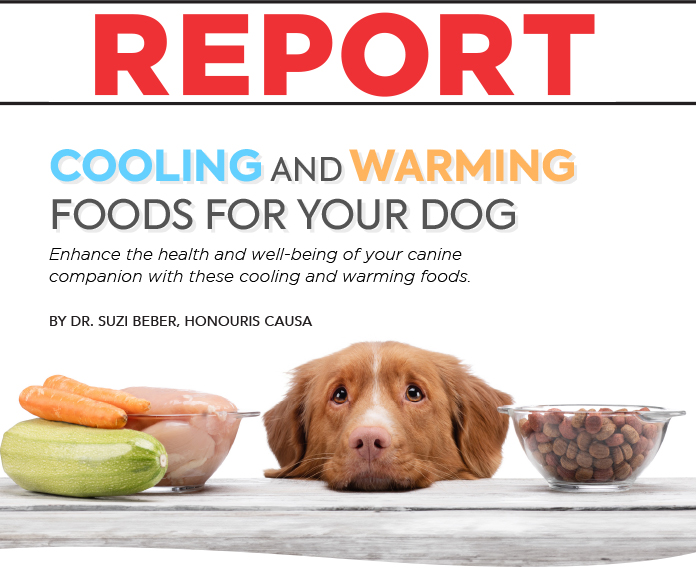
Have you ever heard people talk about cooling or warming foods, either for themselves or their dogs, and wondered what they meant? This terminology is part of the Traditional Chinese Medicine (TCM) approach to health and diet, in which concepts such as Yin and Yang play important roles. Lets explore this approach in more depth, and look at how it can be used to enhance your dogs nutrition and well-being.
A PERSONAL STORY
Growing up in Toronto, my family had a favourite Chinese restaurant, and from time to time, the chef was a very welcome face in our own kitchen. Sometimes he prepared special dishes, carefully explaining why he combined certain foods and spices, and how the different combinations benefitted our health. I was too young to fully understand the Yin and Yang of food and life, but later, I was lucky to be given the opportunity to spend time studying with two Chinese physicians, one of whom was a sixth generation herbalist. He taught me a lot about the universal principles of life and the balance of all things, including the Five Elements. In teaching me that, he also taught me how we can work towards a balance and harmony of foods that meet not only our needs, but also those of our dogs.
UNDERSTANDING YIN AND YANG
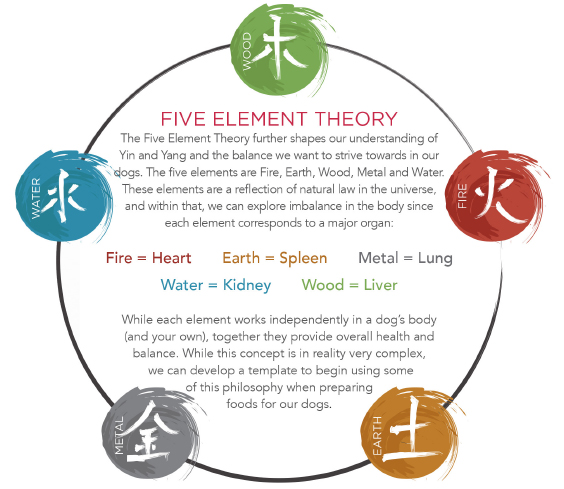
The earliest Chinese characters for Yin and Yang were found on oracle bones. These bones were the skeletal remains of different animals, and were used in ancient Chinese divination practices going all the way back to the 14th century BC. Simply put, Yin is the darkness and Yang is the sunlight. In TCM, this concept of dualism and its fundamental principle underlie physiology, pathology, and the treatment of illnesses.
Yin and Yang classify diseases as either cooling or warming. Warming diseases are treated with cooling foods and herbs, while cooling diseases are treated with warming foods and herbs. Our goal, then, is to work towards a balance of hot and cold in our dogs bodies so that optimal health can be achieved. Such a dog shows no outward sign of illness or disease, doesnt have skin issues, has nice clear eyes, no stinky breath, and a tongue that is a pink/red in colour. Mentally, a balanced dog can adapt to a variety of different environments.
WARMING, COOLING OR NEUTRAL FOODS
All foods have a special energy, whether warming, cooling or neutral. Warming foods increase metabolism, cooling foods decrease metabolism, and neutral foods are just that neutral. Today, we call this TCM-derived approach Food Energetics. The theory suggests that a properly balanced diet keeps your dogs body healthy, and if need be, helps bring back health and harmony when hes challenged with illness and disease. The focus is on the quality of the food rather than its quantity or caloric value and is the perfect descriptor for more does not mean better.
Here is an easy-to-understand example from a great little book called Eastern Food Therapy for Pets by Marc Smith, DVM and Casey Damron, DVM: One type of fish lives in the deepest and darkest part of the lake and another fish lives near the surface of the lake where the water is warmer. The fish at the bottom of the lake are less active and they prefer the cooler temperatures. The fish living closer to the surface of the lake are more active and prefer the warmer temperatures. The fish at the bottom of the lake would be classified as a cooling food, while the fish living closer to the surface of the lake would be considered a warming food.
This is very different from Western food science, which is based on specific amounts of food; focuses on the number of calories found in a cup of food; and looks at how it is metabolized in the body.
COOLING FOODS FOR HOT DOGS
A hot dog is one that is always looking for the coolest place in the house. He will likely prefer lying on tile rather than carpet, and may pant a lot, especially in the evening. He may also be restless, moving from place to place and having difficulty settling down. His skin may be hot to the touch and have patchy red spots. This is a dog who needs cooling foods.
According to TCM, if you feed this dog cooling foods sometimes called Yin Tonic Foods such as white fish (e.g. pollock, cod), duck or rabbit, then hell cool down too. Consider adding some whole fruits and vegetables, like apples, bananas, cranberries, watermelon, broccoli, cauliflower, cucumbers and celery, as well as mushrooms. Add a sprinkle of sea salt, kelp or other seaweeds such as Nori. Whole grains like barley and millet are also suggested for a cooling diet, while buckwheat is another cooling food to consider. To top it all off, add a drizzle of first-pressed sesame or flax seed oil, and a dollop of goat yogurt.
WARMING FOODS FOR COLD DOGS
Cold dogs may experience general weakness and fatigue, as well as exercise intolerance. They may have shortness of breath and be slow-moving, preferring instead to lie around. Cold dogs seek out warm places, and may be stiff after they have been lying down for a while. Cold weather is an invitation to joint pain and even arthritis in these dogs. They may turn away from food.
This is when you can make up a pot of warming foods (Yang or Qi Tonic Foods), such as chicken and chicken liver, turkey, lamb or venison, with some squash and whole oats, a sprinkle of cinnamon, ginger and turmeric, and a drizzle of unsulphured blackstrap molasses. For a warming fishy snack for your dog, try anchovies.

BALANCE HIS YIN AND YANG, AND TONIFY HIS QI, WITH THIS NEUTRAL FOOD FEST
These are very easy recipes to prepare as a sauté in a large pan, or in a slow cooker. They can also be served raw. The foods listed here can be used on their own or in combination, and can also be used to modify a cool or hot diet.
Meats: Beef, beef liver, bison, pork, pork liver, pork, kidneys, tripe
Fish: Mackerel, salmon, sardines, sturgeon, tuna
Meats: Beef, beef liver, bison, pork, pork liver, pork, kidneys, tripe
Vegetables: Cabbage, carrots, green beans, pumpkin, yam, Shiitake mushrooms
Fruits: Pomegranate, raspberries
Grains: Cooked whole brown rice, whole white rice, rye, quinoa
OR
1 pound grass-fed ground beef
/2 pound beef liver
/2 pound beef heart
1 cup quinoa + 2 cups filtered water or broth*
2 tablespoons first-pressed olive oil
1 teaspoon basil, dried
2 teaspoons oregano, dried (oregano promotes Qi circulation, supporting the bladder, heart, kidneys, liver, and spleen)
*When serving this recipe raw, omit the quinoa, or cook and cool it, then add the other ingredients.
Its a good idea to work with a TCM practitioner when using this approach with your dogs food. You can find practitioners in the US and Canada by visiting the College of Integrative Veterinary Therapies online directory. In the meantime, harmonize your dogs Yin and Yang by trying the accompanying neutral recipe (see above), and get on the road to maximizing his health.
[su_button url=”https://facebook.com/AnimalWellnessMagazine” target=”blank” style=”flat” background=”#64d0ff” color=”#3c5e9e” size=”8″ wide=”yes” center=”yes” radius=”0″ text_shadow=”0px 0px 0px #000000″]Visit our Facebook page for more great content![/su_button]