
Lumbosacral radiculopathy remains a challenging and often frustrating cause of chronic pain in dogs, mirroring a well‑recognised condition in human medicine. As veterinary professionals continue to seek targeted, minimally invasive options for managing neuropathic pain, interest in lumbosacral foraminal perineural injections—also known as transforaminal epidural injections—has grown steadily. A recent cadaveric study offers valuable insight into how effectively these injections deliver medication to the intended neural structures.
Why This Technique Matters
Traditional epidural approaches can be limited by diffuse drug distribution, variable efficacy, and the risk of missing the affected nerve root entirely. In contrast, transforaminal injections aim to deliver medication directly around the exiting L7 nerve root, where inflammation and compression commonly occur in dogs with lumbosacral disease. Precision is key—and this study explored whether combining ultrasound and fluoroscopy could reliably guide needle placement and injectate delivery.
Study Overview
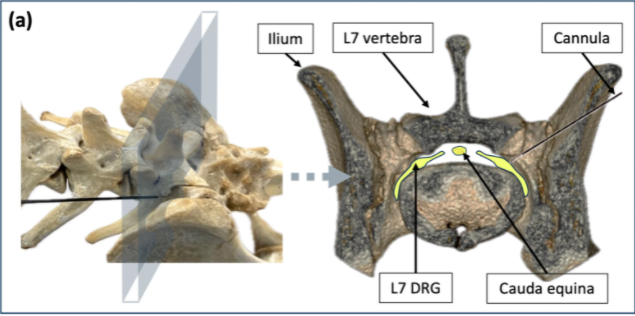
Researchers performed ten injections in five canine cadavers, using a contrast‑dye mixture to track distribution. The needle was advanced under ultrasound guidance toward the cranial aspect of the L7–S1 foramen, with fluoroscopy confirming final positioning. Injectate spread was then evaluated using fluoroscopy, CT imaging, and anatomical dissection.
Key Findings
The results are encouraging for clinicians considering this technique:
- Perineural epidural staining of the L7 nerve root occurred in 90% of injections, demonstrating strong accuracy in targeting the intended region.
- Transforaminal epidural spread medial to the intervertebral foramen was seen in 80% of injections, suggesting effective epidural penetration.
- Subarachnoid spread occurred in 50–60% of injections, a finding that warrants caution and further investigation in live patients.
- Vascular uptake was uncommon (10–20%), indicating a relatively low risk of inadvertent intravascular injection.
- Importantly, consistent needle placement was achievable even when direct nerve visualisation was limited, highlighting the value of combining ultrasound with fluoroscopy.
Clinical Implications
For dogs suffering from lumbosacral radiculopathy—particularly those with refractory pain—targeted foraminal injections may offer a more focused therapeutic option compared to traditional epidurals. The ability to reliably reach the L7 nerve root while minimising vascular uptake is a promising step toward safer, more effective pain management strategies.
However, the high rate of subarachnoid spread underscores the need for caution. While this may not inherently contraindicate the technique, it emphasises the importance of further research in live patients to assess safety, dosing considerations, and clinical outcomes.
Looking Ahead
This cadaveric study provides a strong foundation for future clinical trials. As our understanding of neuropathic pain in dogs evolves, techniques like lumbosacral foraminal injections may become valuable tools in multimodal pain management—offering targeted relief for patients who need it most.