
Discover how cats think and explore recent research revealing their intelligence and remarkable problem-solving skills.
Cats have a unique intelligence that often goes underappreciated. Canine cognition has been widely studied, but most knowledge about how cats think comes from anecdotes shared by cat parents until recently. New research, however, shows cats possess high intelligence and demonstrate it in numerous ways. They can adapt new behaviors to different situations, communicate within social groups, and even respond to training cues. Let’s explore how cats think and what recent findings reveal about feline cognition.
What we know about how cats think
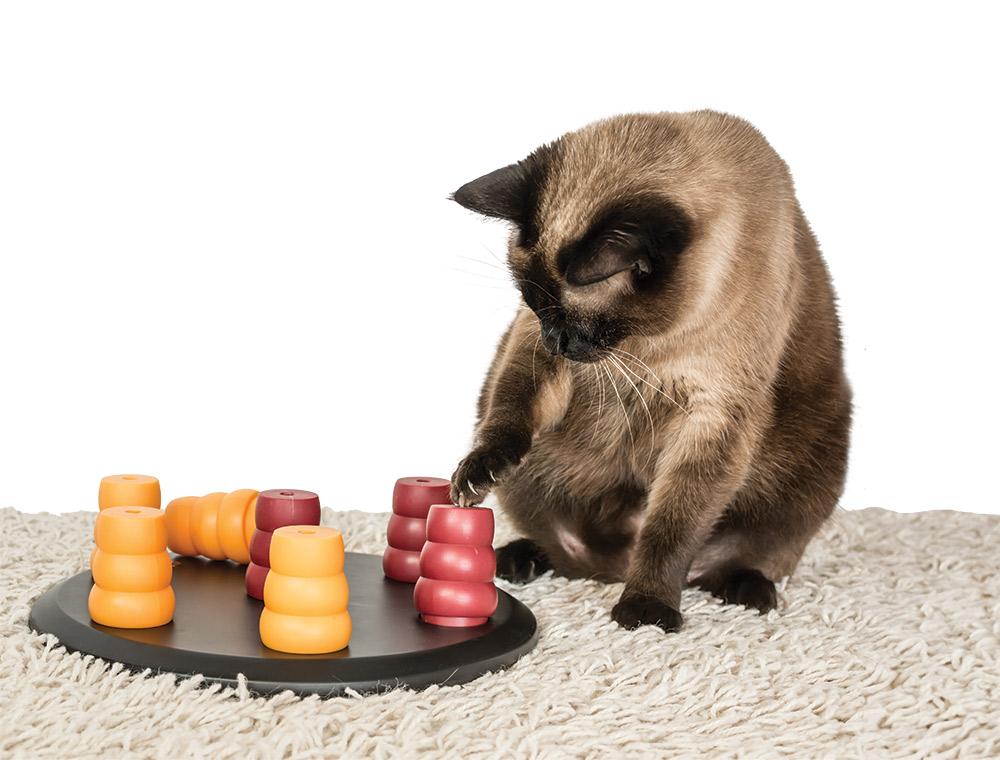
- Research has shown that cats possess a remarkable ability to learn and solve problems. They are naturally curious and have a penchant for exploration.One study presented cats with different puzzles and tasks to solve. Researchers found that cats use logical reasoning to access rewards through trial and error. These findings suggest feline cognition involves a combination of instinct and problem-solving skills.
Did you know? Although a cat’s brain is smaller than a human’s, the anatomy is similar. A cat’s brain is considered fully developed at the age of 12 to 18 months.
- Dr. Mikel Delgado, PhD, cat expert and author of Play With Your Cat, says we often see “emulation,” in which a cat’s attention is drawn to something because another animal (human or cat) is interacting with it.The cat figures out their own way to solve the problem, often through trial and error, without perfectly copying the animal it’s watching” explains Dr. Delgado. “They benefit from the model but are not specifically copying exact movements.”
- Cats can also recognize and distinguish their names from other words, and have the ability to understand human emotions and intentions. They pick up on subtle cues from both their humans’ facial expressions and their body language.Cats can differentiate between happy, sad, or angry states, and respond accordingly. This sensitivity to human emotions is believed to have developed through the cat’s long history of domestication and close relationship with humans.
- Cats engage in social learning, where they observe and imitate behavior. Kittens learn skills and behaviors from their mother and siblings. This social learning continues into adulthood. As most cat parents know, our feline friends can even mimic certain human behaviors, such as opening doors or turning on faucets.
Cats have good memories and a sense of time
Do you remember?
Cats also have an impressive memory. They can remember familiar places, people, and routines. In the wild, this memory retention is crucial for survival and helps cats navigate their territory.
Did you know? Cats can create mental maps of their environment, which may allow them to find their way home even if they venture a long distance away.
The ability to remember routines develops around their humans’ schedules. This helps cats feel safe and confident. In fact, routines are so important to cats that having them disrupted can impact their physical health.
What time is it?
Cats have a keen sense of timing. Most cat parents know their feline charges have an uncanny ability to predict mealtimes.
“Research shows cats have internal clocks that help them anticipate events and establish routines,” says Laura Cassiday, a certified cat behavior consultant.
Dr. Marci Koski, a certified feline behavior and training consultant, further explains how cats develop that internal clock.
“I believe cats use daylight levels and natural sounds to help regulate their internal clocks,” she says. “Cats are often most active during dawn and dusk, when their natural prey are most active as well.” According to Dr. Koski, daylight levels and bird sounds likely cue cats that it’s time to hunt.
“In our homes, this translates to cats wanting to play in the morning and evening, or waking us up for breakfast,” she says. “With my own cats, I’ve noticed they demand dinner based on natural light levels rather than specific times.”
“As the seasons change, my cats’ mealtime alerts seem to be consistent with the days shrinking or growing longer, not necessarily the time the clock says it is.”
Cognitive enrichment is crucial for cats
Because cats are so smart, giving them opportunities to use their minds is important. This is known as cognitive enrichment, and can be accomplished with food puzzles, food “treasure hunts,” interactive playtimes, and rotating toys to keep things fresh.
Did you know? Training stimulates your cat mentally and physically, allowing her to use her problem-solving and memory skills.
Cats have an undeserved reputation for being impossible to train, but nothing could be further from the truth. Clicker training is a successful way to mentally stimulate cats, and it helps them bond with their humans.
Learning how cats think and giving your kitty the best life possible includes giving her opportunities to use that intelligent brain of hers, along with her highly developed senses!
Cats are extremely perceptive
Cats are very perceptive creatures with excellent sensory abilities.
- Feline eyesight is adapted for hunting, with a focus on moving objects. Cats can see in very dim light, which aids them in their nocturnal activities.
- Their hearing, nearly twice as sensitive as a human’s, allows them to detect high-frequency sounds we can’t hear.
- Cats have an incredibly acute sense of smell. They have more than 200 million odor sensors in their noses, while humans only have five million. Their sense of smell is 14 times better than ours. It helps them navigate and communicate with other cats.