
Although the outcomes for dogs diagnosed with hemangiosarcoma have not changed in decades, our understanding of this cancer is slowly but steadily improving our ability to diagnose and treat this deadly disease.
The data is clear: hemangiosarcoma is a deadly cancer. Within one year of diagnosis, 90% of dogs with hemangiosarcoma will die even with treatment. At two years, mortality reaches almost 100%. This prognosis hasn’t budged in nearly 30 years, despite decades of research. However, newer advances in technology are enabling researchers to explore hemangiosarcoma in ways previously impossible, and there is reason to hope that new discoveries could change the way veterinarians diagnose and treat this terrible cancer in dogs.
NEW IDEAS ON PATHOGENESIS
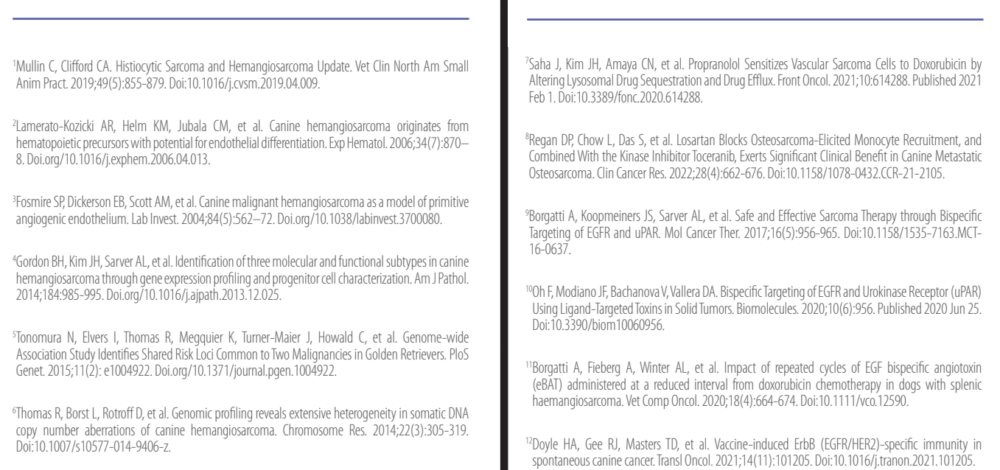
For decades, it was thought and taught that hemangiosarcoma arose from vascular endothelial cells, which explained the tumor’s predilection for areas with a rich blood supply. This commonly held belief was first challenged just over ten years ago, and many veterinary oncologists feel hemangiosarcoma arises from endothelial cell precursors in the bone marrow, and then spreads to other areas of the body.1-3
Another concept being explored is the idea that hemangiosarcoma is not one tumor but includes different subtypes. In 2014, a team at University of Minnesota reported they had identified three subtypes based on genetic signatures:4
- Angiogenic vascular form
- Inflammatory immune component
- Adipogenic lipid characteristics
It is still unclear whether the subtype influences prognosis or treatment, but more work is planned in this area.
NEW IDEAS ON RISK FACTORS AND GENETICS
Another long-held belief is that hemangiosarcoma has a predilection for large breed dogs, and many studies suggest this is true. But recently, some researchers have called this into question; they believe the data showing this may simply reflect breed popularity (A. Borgatti, oral communication, June 2023).
The question of breed predilection is being explored by looking at the genetics underlying hemangiosarcoma, but this work is still an area of active research. Breeding the disease out of a particular breed, so to speak, might be impossible, but finding a genetic marker that could identify dogs at higher risk, along with precautionary measures or closer monitoring of the dogs, might be indicated. Having this information could also influence breeding decisions.
At Morris Animal Foundation, we have funded past and current studies that aim at looking for a gene or genes associated with hemangiosarcoma.
- One of the first groups to publish on heritability of hemangiosarcoma was the MADGiC study, a collaborative effort between the University of Minnesota, the Broad Institute, the University of Uppsala, and North Carolina State University. The team studied Golden Retrievers and identified two regions of interest that together explain part of the risk for hemangiosarcoma and lymphoma in this breed.5,6
- A more recent study in progress leverages advances in genomics to build on this work. A team from the University of Utrecht will use genomic information collected from participants in Morris Animal Foundation’s Golden Retriever Lifetime Study to look for genetic markers that develop hemangiosarcoma as another step toward diagnostic testing and possibly targeted therapy.
ADVANCES IN DIAGNOSTIC TECHNIQUES
As most veterinarians know, hemangiosarcoma is rarely diagnosed until the disease is advanced enough to become an emergency. Finding a way to diagnose this cancer early would allow for quicker intervention and possibly improve the odds for dogs with hemangiosarcoma.
The term “liquid biopsy” is ubiquitous in the media and has both positive and negative connotations in our imaginations. However, the basic concept is that cancer cells shed unique substances in the blood that differ from products made by non-cancerous cells; this concept is supported by accumulating evidence from numerous studies. Developing a reliable and accurate method to detect these products is an area of active research, and a growing number of companies are offering tests based on this principle.
The compounds most commonly detected and measured in liquid biopsy tests include circulating tumor DNA and circulating tumor cells. MicroRNA and extracellular vesicles are also being looked at as possible diagnostic testing items. In addition, some researchers are looking at the “omics” such as proteomics and metabolomics to craft new diagnostic tests for cancer detection.
Some experts feel that in addition to their benefit as an early diagnostic modality, these tests could provide a means to monitor a patients response to therapy, or detect if and when a patient relapses.
Lastly, liquid biopsy results might help guide therapies. Liquid biopsy results have been used to determine a specific therapeutic approach in some human cancer patients and could hold a similar promise for our veterinary patients.
NEW THERAPIES ON THE HORIZON
Only a handful of treatments are available for dogs with hemangiosarcoma. Although surgery will still be an important treatment for many of these dogs, the hunt is on to find more effective therapies. Several interesting developments made in the last few years are beginning to make their way into clinical practice.
One of the most intriguing discoveries centers around the use of anti-hypertensive medication in the treatment of canine cancer.
The most well-known and promising is the use of beta-blockers, specifically propranolol. Thinking back to the subtypes of hemangiosarcoma described earlier, researchers found that, in vitro, the addition of propranolol sensitized vascular sarcoma cells to doxorubicin.7
A new multi-center study is in progress, looking at the combination of these two drugs in clinical cases of hemangiosarcoma.
Losartan, an angiotensin II receptor blocker used to treat hypertension, is also getting a second look as a potential adjunct therapy for cancer in dogs. Work done at Colorado State University demonstrated that losartan, in combination with toceranib, showed a clinical benefit in dogs with metastatic osteosarcoma.8 A clinical trial underway at Schwarzman Animal Medical Center is studying the effect of losartan in combination with doxorubicin in dogs with hemangiosarcoma.
The Shine On Study, an ambitious project entering its final phase at the University of Minnesota, is focused on early diagnosis and treatment of hemangiosarcoma. In the studys first phase, the team developed a new blood test aimed at diagnosing hemangiosarcoma. In the second phase, the team wanted to see if this test could detect treatment failure, or recurrence of disease in dogs undergoing treatment. The answer was yes! Now, in phase three of the study, the team is using the test to find dogs at high risk of hemangiosarcoma. In those dogs, the team is using a drug called eBAT as a preventive measure. Ultimately, the group will determine if eBAT was successful at preventing cancer development in this group. In addition, eBAT was shown to be safe and improve survival in dogs with hemangiosarcoma.9-11
A new cancer immunotherapy, developed at Yale University, is in clinical trials. The EGFR/HER2 vaccine study is enrolling patients at participating clinics. The vaccine exploits the overexpression of EGFR common to several tumor types by stimulating antibody production against EGFR through immunization, using a peptide of EGFR that shares similarities to HER2.12
IMPROVING ODDS FOR DOGS WITH HEMANGIOSARCOMA
At Morris Animal Foundation, hemangiosarcoma is one of our top focuses for research. The Foundation launched its Hemangiosarcoma Initiative in the fall of 2022 to specifically address the many knowledge gaps around the disease. This multiyear, multimillion-dollar effort is providing funding and resources to advance the prevention, detection and treatment of hemangiosarcoma.
We recently completed our first call for proposals, with six projects advancing for additional review and final approval. All projects are slated to begin in late 2023 or early 2024. Topics submitted include novel tests for early diagnosis; novel therapies; and the development of genomic breeding values to reduce the incidence of hemangiosarcoma.
THE GOLDEN RETRIEVER LIFETIME STUDY AND HEMANGIOSARCOMA
The Golden Retriever Lifetime Study is one of the largest and most comprehensive prospective canine health studies in the US. Its purpose is to identify the nutritional, environmental, lifestyle and genetic risk factors for cancer and other diseases in dogs. Each year, with the help of veterinarians and dog owners, the Foundation collects health, environmental, and behavioral data from 3,000+ enrolled Golden Retrievers.
At the study’s inception, four cancers were considered of primary interest:
- Hemangiosarcoma
- Lymphoma
- Osteosarcoma
- High-grade mast cell tumor
As of July 15, 2023, 331 dogs have been diagnosed with hemangiosarcoma, accounting for roughly 61% of the cancers of primary interest. Of all deaths to date, 75% are cancer related; of those deaths, almost 70% are due to hemangiosarcoma.
The Foundation is making the samples and/or data available to researchers on a rotating cycle throughout the year. In addition, researchers applying for funding through the Hemangiosarcoma Initiative also are encouraged to use study samples and data.
Although the outcomes for dogs diagnosed with hemangiosarcoma have not changed in decades, our understanding of this cancer has made slow but steady progress toward improving our ability to diagnose and treat this deadly cancer. Recent discoveries are raising hopes that well be able to offer our patients and clients a path to a longer and better quality of life.
ADDITIONAL RESOURCES
Podcasts and videos
TEDxMileHigh – Hemangiosarcoma: what every dog owner needs to know and research insights
Fresh Scoop podcast episode 50: Repurposed and translational drugs
Fresh Scoop podcast episode 52: New Ideas on hemangiosarcoma in dogs
Publications
Dow S. A role for dogs in advancing cancer immunotherapy research. Frontiers in Immunology. 2020;10. doi:10.3389/fimmu.2019.02935. An excellent review of immunotherapy; includes a table of studies previously published.
Kim JH, Graef AJ, Dickerson EB, Modiano JF. Pathobiology of hemangiosarcoma in dogs: Research advances and future perspectives. Veterinary Science. 2015;2(4). doi:10.3390/vetsci2040388. The team from University of Minnesota reviews basic research with an excellent discussion of their work on identifying tumor subtypes.
Sarver AL, Makielski KM, DePauw TA, Schulte AJ, Modiano JF. Increased risk of cancer in dogs and humans: a consequence of recent extension of lifespan beyond evolutionarily-determined limitations? Aging and Cancer. 2022;3(1). doi:10.1002/aac2.12046. An interesting thought piece providing a possible explanation for increasing cancer rates.