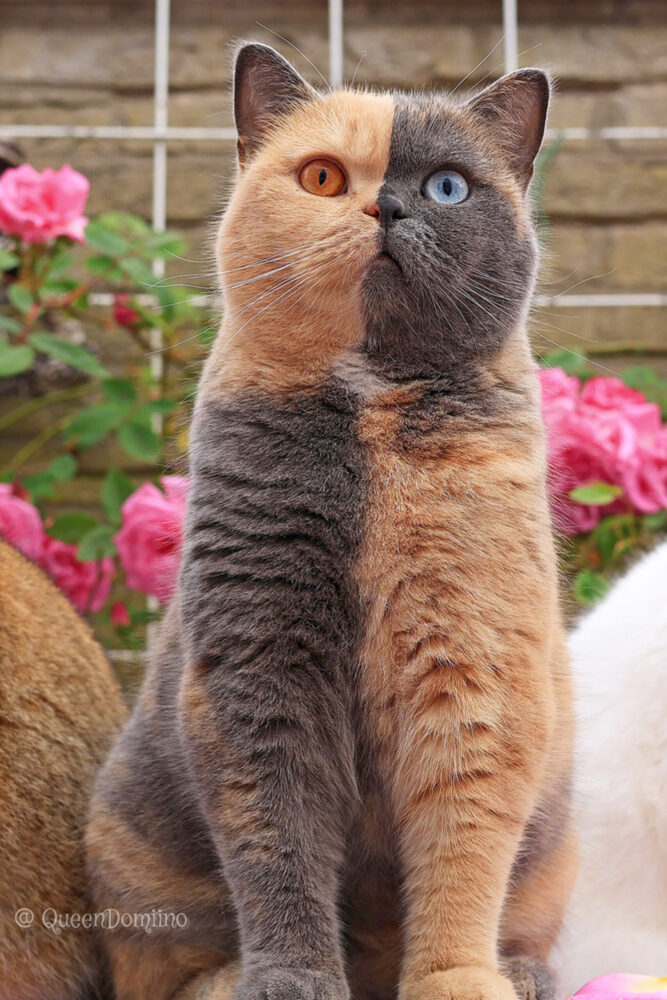
Two-faced and chimera cats look almost too stunning to be real, but they are! Discover the fascinating science behind this rare phenomenon, from chimerism to unique genetic variations, and learn why these cats are some of the most extraordinary in the world.
Social media is full of cat videos and photos. These famous felines often have distinctive physical appearances (think Lil Bub) or humorous facial expressions (like Grumpy Cat). “Two-faced” cats such as Venus, Quimera, Narnia and Queen Domiino are particularly eye-catching. These striking felines have sharply delineated and symmetrical facial markings that make them look like two cats spliced together. How does this phenomenon occur?
Many two-faced cats are chimeras
Chimerism happens when cells from two different embryos fuse in the early stages of pregnancy. This results in a cat becoming one with its non-identical twin.
Embryo fusion can result in an XY/XY genotype if two male embryos fuse. It can result in XX/XX if two female embryos fuse, or XY/XX if a male and female embryo fuse. Contrary to popular belief, many chimera cats are fertile.
Fun fact: The word “chimera” is rooted in Greek mythology and describes a fire-breathing female monster resembling a lion in the front, a goat in the middle and a dragon at the rear.
In well-known cases of chimerism, cats have different colored eyes (heterochromia) and/or a “split” face of two distinct colors. For example, one side of the face might be black, and the other side orange, while one eye might be blue and the other green.
When “two” faces aren’t chimerism
Not all cats with two faces are actual chimeras. For example, calico and tortoiseshell cats are not the same as chimeras, even if they have similar markings. Cat geneticist Leslie Lyons explains that some tortoiseshell cats are mosaics. This means a single fertilized egg resulted in a variety of genetic lines.
Calicos and tortoiseshells display a wide variety of coat patterns and colors. These may include different colored eyes and “split” faces, but that doesn’t mean they are true chimeras.
Fun fact: People can also be chimeras. Only about 100 cases of human chimeras have been recorded, likely because they display only minor traits, such as minimal skin discoloration. In other words, you might be a chimera and not necessarily know it!

Chromosomal condition mimics chimerism
XXY syndrome, also known as Klinefelter syndrome, is a condition characterized by an additional chromosome. It occurs in male cats and can cause chimera-like markings and sterility. Other health problems, such as developmental issues and a shorter lifespan, may also occur.
Genetic testing is the only way to determine for certain if a cat is a true chimera.
“We can do a DNA fingerprint — just like on CSI. The DNA from one side of the body should be different than the other,” Leslie says.
Fun fact: Heterochromia doesn’t affect eyesight. Hereditary deafness can occur in white cats, especially if one or both irises are blue.
Whether the two-faced cats you see on social media are true chimeras or simply have luck-of-the-draw colorings and markings, you can’t deny their charm!
FAQs:
What are Chimera cats?
Chimera cats are rare felines that appear to have two different faces split down the middle, often with strikingly different fur colors on each side. This unique look happens when two embryos fuse together in the womb, creating one cat with two sets of DNA.
Why does the Chimera cat look this way?
The split-face appearance comes from genetic chimerism, where cells from two embryos combine into a single kitten. This fusion can result in bold patterns, such as a perfectly divided face with contrasting colors, making them look almost photoshopped.
Are all split-faced cats chimeras?
Not always. While many split-faced cats are true chimeras, some cats simply have rare coat patterns that mimic the same look. A DNA test is the only way to confirm if a cat is genetically chimeric.
Do Chimera cats have different colored eyes?
Some Chimera cats do have heterochromia, meaning each eye is a different color, but it’s not guaranteed. The unique DNA mix can increase the chance of unusual eye colors, but not every Chimera cat will show this trait.
Are Chimera cats the same as Calico and Tortoiseshell cats?
No, they’re different. Calico and Tortoiseshell cats get their patchy coats from genetics tied to the X chromosome. Chimera cats, on the other hand, result from two embryos merging, which can create much sharper and more dramatic color divisions.
What is the cat breed with two faces?
Chimera cats are not a separate breed—they can occur in any breed or mixed breed. The two-faced look is a genetic phenomenon, not something specific to a bloodline.
What are a Chimera’s characteristics?
Chimera cats often have a strikingly split face, with one side a different color than the other. Their fur patterns can extend to the body, and in some cases, they may also show eye color differences. Other than their appearance, their personality and behavior are the same as any other cat.
Do Chimera cats have health issues?
In most cases, Chimera cats are completely healthy. The condition mainly affects their appearance and doesn’t usually cause medical problems. Like all cats, their health depends more on diet, genetics, and overall care than on being a chimera.
Final Words:
Chimera cats are truly one of nature’s most fascinating wonders. While their split-faced look may seem mysterious, they are just like any other cat when it comes to love, care, and companionship.
Whether you’re captivated by their genetics, curious about their unique appearance, or simply love learning about rare feline traits, exploring the world of Chimera cats shows how amazing our pets can be.
To deepen your knowledge and better care for your feline friends, check out online cat courses and learn from experts in the field.