
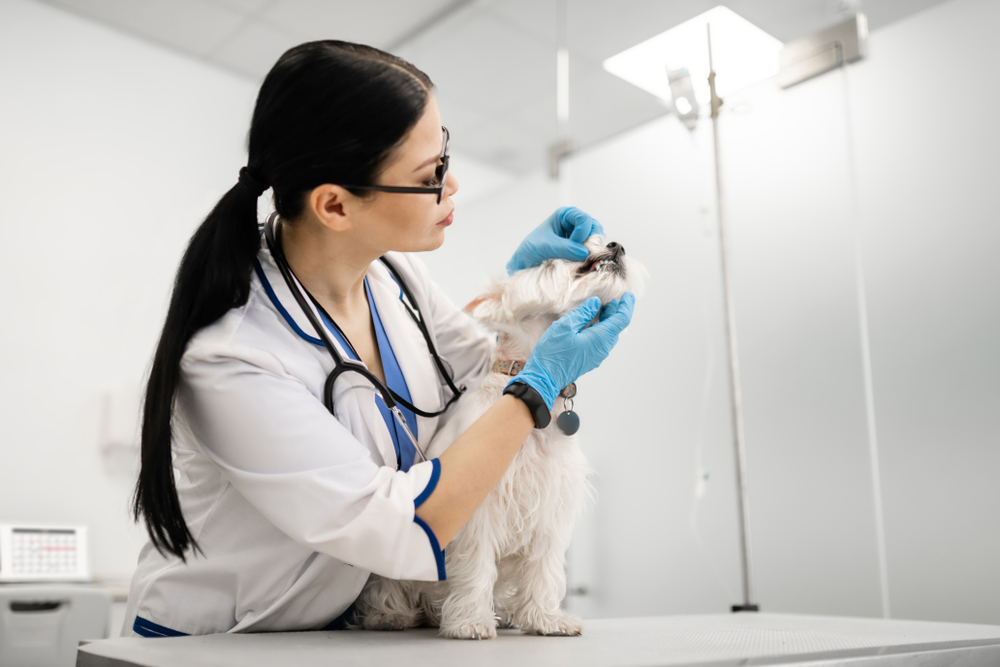
Unlocking a new technology to decrease oral pain and improve quality of life for dogs and cats with dental issues.
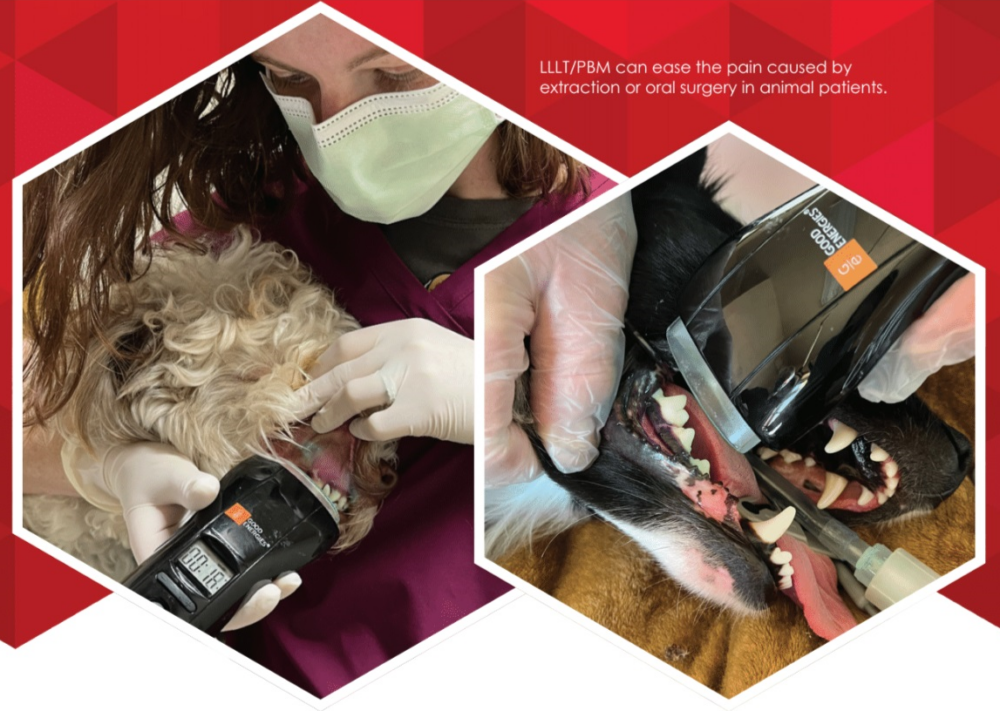
When veterinary dentists hear the word laser, they often think of a hard or soft tissue laser used to cut enamel or soft tissue. Low Level Laser Therapy (LLLT) or Photobiomodulation (PBM) is a new subset of laser therapy that can improve clinical outcomes and decrease the pain felt by a dog or cat after a dental appointment.1 LLLT accomplishes this by stimulating endorphins; reducing the conduction of nerve fibers that can carry pulpal pain (c-fiber); stimulating fibroblasts, osteoblasts, and odontoblasts; and increasing circulation and lymphatic drainage.
LLLT/PBM AND ITS EFFECTS ON BODY TISSUES
LLLT, PBM, cold laser, or red light therapy5 is a form of medicine that applies low-level (low-power) lasers or light-emitting diodes (LEDs) to the surface of the body. The effects of PBM are a result of photons packets of electromagnetic energy interacting with cells. In the clinical setting, therapy lasers that emit near infrared light are most often used. Different from LEDs (light-emitting diodes), therapeutic diode lasers emit invisible light in the 800 nm to 1,000 nm range. These therapeutic wavelengths are less absorbed by water and other non-target chromophores within the tissue, and therefore achieve greater depth of penetration. They also interact with target chromophores to produce photochemical changes within the tissue.6
The key to PBM is the absorption of photonic energy by chromophores within cells. The chromophore cytochrome oxidase is concentrated within mitochondria; it absorbs the energy in photons and delivers it into metabolic processes, including the Krebs cycle. This results in increased ATP production, as well as increased levels of nitric oxide and reactive oxygen species, important in cellular signaling. Metabolic activity increases, and cell growth and reproduction are accelerated.6
CLINICAL APPLICATIONS IN HUMAN DENTISTRY
In his clinical studies, Dr. Gerry Ross, DDS, lists some of the most frequently used applications of LLLT/PBM in human dentistry.
For example, LLLT/PBM decreases pain, swelling, bruising and inflammation after an extraction. This decreases and can even eliminate the need for post-operative analgesics. Dr. Ross adds that the speed of healing at the extraction site is increased.
LLLT/PBM not only reduces pain, but also hastens covering of the exposed bone through the stimulation of fibroblasts.
Dr. Ross goes on to say that LLLT/PBM can be applied to the submandibular lymph nodes to increase lymphatic flow in the infected area; reduce the inflammatory cells; and bring neutrophils to the site of infection for faster healing. Laser therapy will not preclude the use of antibiotics in most cases, but will help potentiate the uptake of antibiotics into the bloodstream.
One of the most interesting and useful aspects of LLLT/PBM, Dr. Ross adds, is that it only elicits responses from cells that can use the energy produced, and will therefore have no negative effect on healthy cells. In the hundreds of studies done on laser therapy, no clinical side effects have been reported. The very nature of what dentists do causes pain and inflammation, but LLLT/PBM requires a paradigm shift; instead of using drugs to treat the pain after it has started, a dentist now has the opportunity to treat the pain immediately in the dental office.
Further, LLLT/PBM may reduce third molar surgery pain.2 According to the results of a clinical trial recently published in BMC Oral Health, administering a session of extraoral low level diode laser after exodontia of the third molar may decrease patient pain.
THE HISTORY OF LLLT/PBM IN VETERINARY MEDICINE
LLLT/PBM is a rapidly growing treatment modality used for a variety of medical conditions in companion animals. Its painless, noninvasive, and easily administered in a primary care setting. Its estimated that therapeutic laser devices are used by 20% of all companion animal practices in North America. LLLT/PBM accelerates healing in a number of tissues, provides analgesia, and decreases inflammation through the modulation of immune and inflammatory responses. It has been used in both human and veterinary medicine to improve wound healing, treat snake bites, decrease pain and inflammation resulting from musculoskeletal conditions, improve neurologic function after trauma or injury, treat stomatitis and other oral inflammatory conditions, treat intraoperative and postoperative inflammation, and enhance healing of sport-related injuries.4
PILOT STUDY ON LLLT/PBM FOR REDUCING ORAL PAIN
The Oral Care Department at Silver Sands Veterinary in Milford, CT is in the midst of a pilot study to determine the benefits of LLLT/PBM in reducing pain and decreasing healing time for multiple oral problems. The areas of consideration in multiple clinical oral applications in companion animal dentistry include:
- Post extraction, post oral surgery, and convalescence
- Advanced periodontal surgery
- Post care of patients being treated for gingival hyperplasia with radiosurgery
- Pain control following oral surgery for feline and canine stomatitis. (LLLT/PMB is being studied for adjunct pain and inflammation control in these patients, and is not being advocated as a primary treatment in these conditions)
- Post oral orthopedics: after the repair of oral trauma
The present trials small sample size limits definitive statements on treatment recommendations by the author the study is ongoing.
The study includes an assessment of various areas after LLLT/PBMT treatment:
- Edema and swelling post surgery
- Healing time
- Pain assessment through subjective reviews with clients via telemedicine, in conjunction with objective evaluation onsite by the SSV Health Care Team.
LLLT/PBM should not be used without a complete intraoral and extraoral examination and a definitive diagnosis of the pathology present in the patient. It should not be considered the silver bullet of oral care, but rather, another innovative tool in the treatment of oral pain. Never substitute LLLT/PBM for the proper oral care diagnostics and treatment as recommended by the American Veterinary Dental College (AVDC) see their position paper on non-sedation oral prophylaxis7
COMPANION ANIMAL DENTAL SCALING WITHOUT ANESTHESIA7
In the United States and Canada, only licensed veterinarians can practice veterinary medicine. Veterinary medicine includes surgery, medicine and dentistry. Anyone other than a licensed veterinarian, or a supervised and trained veterinary technician, may not provide dental services; if they do, theyre practicing veterinary medicine without a license and will be subject to criminal charges.
This position statement addresses dental scaling procedures performed on pets without anesthesia, often by individuals untrained in veterinary dental techniques. Although the term anesthesia-free dentistry has been used in this context, AVDC prefers the more accurate term non-professional dental scaling (NPDS) to describe this combination. Pet owners are naturally concerned when anesthesia is required for their dogs and cats. However, performing NPDS on an unanesthetized pet is inappropriate for the following reasons:
Dental tartar is firmly adhered to the surface of the teeth. Scaling to remove tartar is accomplished using ultrasonic and sonic power scalers, plus hand instruments that must have a sharp working edge to be used effectively. Even a slight head movement from the patient could result in injury to their oral tissue, and the operator may be bitten when the patient reacts.
Professional dental scaling includes scaling the surfaces of the teeth both above and below the gingival margin (gumline), followed by dental polishing. The most critical part of a dental scaling procedure is scaling the tooth surfaces within the gingival pocket (the subgingival space between the gum and the root), where periodontal disease is active. Because a human patient cooperates, dental scaling performed by a trained professional can be completed successfully without anesthesia. However, access to the subgingival area of every tooth is impossible in an unanesthetized canine or feline patient. Removing dental tartar on the visible surfaces of the teeth has little effect on a pets health, and provides a false sense of accomplishment. The effect is purely cosmetic.
Inhalation anesthesia using a cuffed endotracheal tube provides three important advantages: the patients cooperation during a procedure they do not understand; elimination of the pain resulting from examination and treatment of affected dental tissues during the procedure; and protection of the airway and lungs from accident- al aspiration.
A complete oral examination, an important part of a professional dental scaling procedure, is not possible in an unanesthetized patient. The surfaces of the teeth facing the tongue cannot be examined, and areas of disease and discomfort are likely to be missed.
The safe use of an anesthetic or sedative in a dog or cat requires an evaluation of the general health and size of the patient to determine the appropriate drug and dose, and continual monitoring of the patient. Veterinarians are trained in all these procedures. The prescription or administration of anesthetic or sedative drugs by a non-veterinarian can be very dangerous, and is illegal.
Although anesthesia will never be 100% risk-free, modern anesthetic and patient evaluation techniques used in veterinary hospitals minimize the risks, and millions of dental scaling procedures are safely performed each year in veterinary hospitals.
The AVDC supports the guidelines of safe administration of general anesthesia to animals for dental procedures as outlined by the American College of Veterinary Anesthesiology and Analgesia (ACVAA).
CONTRAINDICATIONS OF LLLT/PBM
For over 40 years, a list of contraindications around LLLT/PBM has accumulated and been passed down, often repeated in publications and device manuals, without consideration of whether they are valid.
- Currently, the one absolute contraindication is exposing the retina to a direct or reflected beam transmitted through the pupil. Scattered photons reaching the retina via adjacent tissue treatment are not the concern; penetration through the pupil is.6
- Since there is no knowledge about how different wavelengths of light interact chemically with medications, and one does not want to alter the rate of medication absorption, do not treat over areas into which medication or vaccines have been injected. Apply laser therapy to tissue before injecting, and do not treat the area again until the injection has been absorbed.6
- It is contraindicated to treat over a malignancy, or the surgical site from which a malignancy has been removed. Contradictory data from the laboratory indicates that some malignant cell lines are stimulated, some are inhibited, while LLLT/PBM has no effect on others. There is no contraindication for treating a site distant to a malignancy, and it is valid to treat areas of malignancy, with informed owner consent, for pain management in hospice care.6
- Historically, treating over a gravid uterus has been contraindicated. This was based on studies done decades ago, in which chicken embryos showed cellular changes when exposed to high doses of visible red light through an eggshell window. This has no practical application to the clinical treatment of patients. Near infrared light is neither mutagenic nor teratogenic, and an embryo or fetus within a gravid uterus is well protected from photons which are readily absorbed by multiple layers of chromophores in the surrounding tissues.6
- Do not treat areas of active hemorrhage, since transient vasodilation is induced. Once hemorrhage has stopped, laser therapy will not reactivate it.6
- Treatment over active epiphyses, the testicles, or the thyroid glands all require similar consideration. Treatment with high doses for a prolonged time has been demonstrated to produce change in these tissues. However, negative effects are not reported with lower dose treatment over shorter periods.6
This article acknowledges the proposed benefits of LLLT/PBM in companion animal oral care, based on present data from human dentistry. The present pilot study at SSV concerns only oral applications in the dog and cat. Even with positive results to date, the pilot study numbers are too small to advocate the use of LLLT/PBM in all oral applications under consideration in the study. Contact a veterinary dentist in your community, review the LLLT/PBM units now available to veterinarians, and follow their recommendations.
USING LLLT/PBM TECHNOLOGY
Its important to contact the manufacturer of the LLLT/PBM unit for their recommendation on usage, and the length of time needed to treat the site or problem. Note as well that some lasers require eye protection for both the operator and the patient. Again, the manufacturer can guide the veterinarian or veterinary dentist concerning eye protection. However, even in units cleared to be used without eye protection, the laser beam should never be aimed at the patients or operators eyes.3
RECOMMENDING HOME DENTAL CARE
To minimize the need for professional dental scaling procedures, and maintain optimal oral health, the AVDC recommends daily home dental care from an early age. This should include brushing or the use of other effective techniques to retard accumulation of dental plaque, such as dental diets and chew materials. Combined with periodic examination of the patient by a veterinarian, and dental scaling under anesthesia when indicated, this will optimize lifelong oral health for dogs and cats.
No recommendations concerning the usage of LLLT/PBM in veterinary dentistry is being provided by the author at this time. Efficacy will be accomplished through continued data collection. LLLT/PBM is the new kid on the block as an adjunct to human and veterinary oral care. The pilot study will continue to evaluate efficacy, safety, and patient benefits in reducing oral pain.
TO LEARN MORE
- For general information on the performance of dental proce dures on veterinary patients, please read the AVDC Position Statement on Veterinary Dental Healthcare Providers. You can also send an e-mail to the AVDC Executive Director.
- For further information on effective oral hygiene products for dogs and cats, visit the Veterinary Oral Health Council
Disclosure: Dr. DeForges research on LLLT/PBM in veterinary dentistry is being conducted in the absence of any commercial or financial relationship that could be construed as a potential conflict of interest.