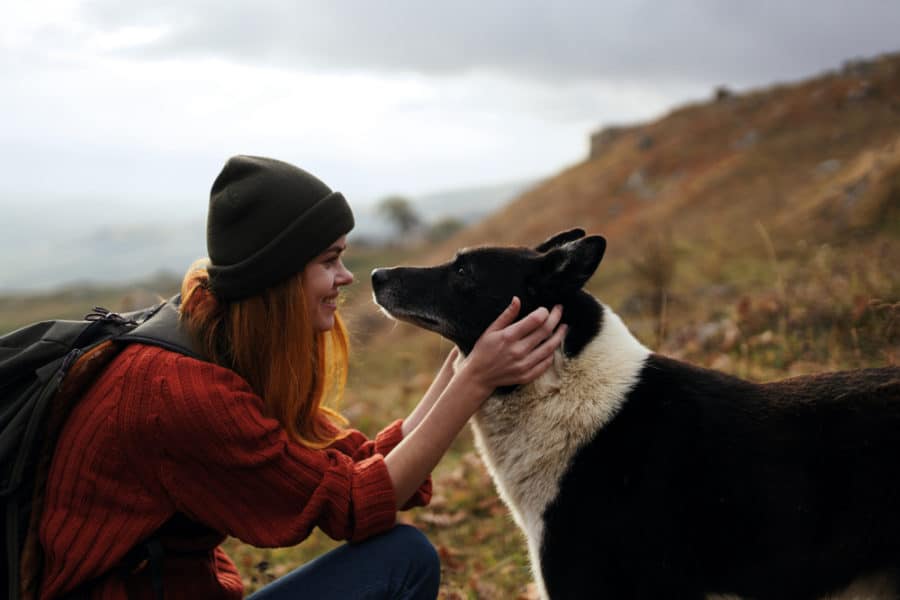


While neuroplasticity is an established and well-studied phenomenon in human brains, less is known about if or how it applies to animals. This article looks at the evidence, and shows how challenging our animals brains with new experiences demonstrates neural plasticity.
Neuroplasticity, or brain plasticity, has varied definitions when it comes to humans. Essentially, it describes the brains ability to change in structure or function in response to experience, how it rewires to integrate new information. Simply put, neuroplasticity is an internal rewiring process that allows the mind to grow and meet new, increased demands.
The ability of neural networks to change through growth and reorganization has been acknowledged and taught in numerous medical schools. I took my first course relating to the subject decades ago through Harvard Medical Schools Department of Mind/Body Medicine. There were 1,000 MDs in the audience, but I was the only veterinarian. However, I dont feel it is unreasonable to accept that most, if not all, vertebrate brains (perhaps non-vertebrate too) are neuroplastic. This article, perhaps the first or among the first on this topic, focuses on the potential ability of non-human animal brains to build mental muscle when their minds are challenged and given new experiences.
Neuroplasticity starts at birth
Newborn babies look to their parents to learn how to survive outside the womb. This behavior is also evident in puppies, kittens, foals, etc. It is their first exercise in neural plasticity. Parents continue to train their offspring in the ways that helped them survive when they were young. One of the papers I published for my masters degree in animal behavior focused on the development of play behavior in foals. Play is an easy, early form of learning and is directly related to the mothers dominance order in a herd.
Brains adapt and remain flexible throughout life
Neuroplasticity results in both functional and physical changes inside the cranium. New synaptic connections form between billions of neurons as the brain takes in novel information. The brain continuously undergoes rewiring from learning new experiences.
For example, as animals meet another of their own species, they mentally adjust to communicating with them vocally and physically. A submissive dog may roll over to expose their belly as they confront a more dominant dog. Cats may hiss at each other until they acknowledge their dominance order.
Agility training is another classic example of neuroplasticity in animals. Two of my staff members routinely took their adult dogs to an agility course, offering them new tricks, going through variously-sized tunnels, and leaping over increasingly high jumps. The dogs excitement about learning new tricks was quite evident.
Repetition is important for neural plasticity
Dr. Richie Davidson from the University of Wisconsins Department of Investigating Healthy Minds shared a mind/body medicine adage with me: You fire what you wire and you wire what you fire. This saying addresses the importance of repetition regarding neural plasticity.
Glial cells make up the connective tissue that surrounds nerves in the brain. The more you repeat something, the more glial cells surround the nerve that fires. This is why you fire pathways for things you do continuously and often, including both positive and negative patterns.
Repetition is the mother of memory. For example, the more you play a musical instrument, the better you get. This is also why riding the same trails helps make horses more comfortable with them, and why dogs feel increasingly comfortable on routine walks. In addition, it helps mynah birds and parrots learn repeatedly-heard human phrases. Two mynah birds bequeathed by an elderly client would make me belly laugh at the words they would say.
Applying neuroplasticity to animal patients
Just like other muscles in the body, keeping mental muscles fit and powerful requires work. Approaches to improving neuroplasticity in humans can also be applied to animals. Research shows that novelty and challenge can enhance the cognitive function of dogs, cats, horses, birds etc. Here are some ideas you can suggest to clients:
- Challenge the animals brain regularly with new activities and experiences. In the case of horses, this could include different riding trails or a new style of riding. I have seen racehorses adapt quite well to becoming hunter/jumpers or trail riding horses. Agility dogs enjoy learning new courses, while cats love new and novel toys.
- Build the concept of new experiences into the animals day-to-day life with some simple acts. The idea is to break their routine, even just slightly. Einstein said that imagination is more important than knowledge. What might imagination include when it comes to new experiences in your animal friends lives?
- Add something different to the animals exercise routine. Taking dogs on new walking routes to various stores, hiking trails or neighborhoods is good for their brains.
- Consider travelling with dogs, even short distances. Travel to novel places stimulates new neural pathways. Brains are forced to stop auto-piloting in unfamiliar environments. Dogs also love looking out car windows, especially while youre exploring new areas.
- Periodically place bird cages in new, safe environments with novel views to stimulate their brains. The same goes for any caged animal, whether winged, scaled, etc.
- Play varied music its good for animal brains. I have seen parakeets and parrots start flapping their wings and singing voraciously to new music they resonate with.
- Teach parrots and parakeets new words. They seem to love it (positive words are better, in my opinion).
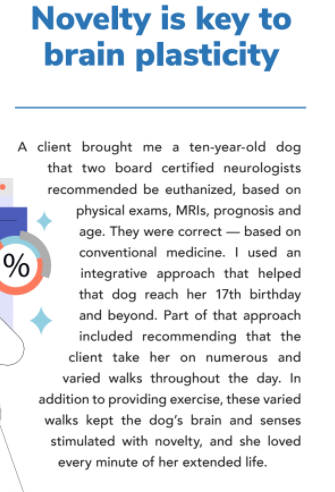
- Ensure the animal also gets sufficient rest. This is important for neuroplasticity; the brain needs time to incorporate the days activities, especially new ones. There is a balance too much rest and the animal becomes a couch potato, but too little and they are exhausted. The old dog I was treating for brain abnormalities (see sidebar) would be taken for walks in novel areas, go into a deep, restful sleep for a while, then wake up re-energized.
Every time an animal learns or does something new, the brain creates a new connection. As stated previously, repeating that action reinforces this connection.
See what works for you and your patients and keep me posted if youre interested in more concepts to enhance neuroplasticity in your animal companions and patients, contact me through IVC Journals Associate Editor at dromer@ivcjournal.com.