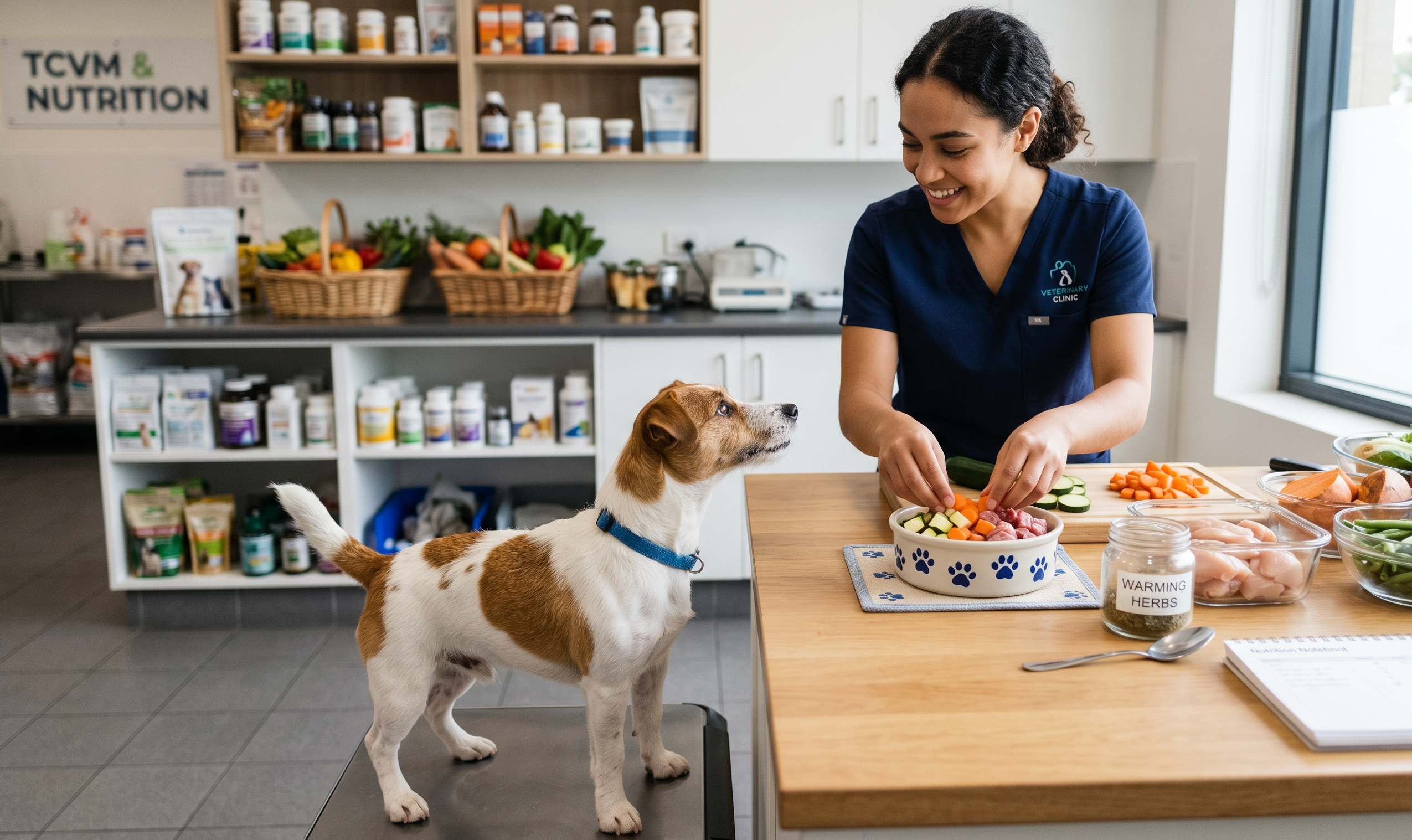
As integrative veterinary medicine continues to grow, more practitioners are exploring ways to blend Eastern and Western approaches to patient care. One area gaining attention is Traditional Chinese Veterinary Medicine (TCVM) Food Therapy — a system that classifies foods by their energetic properties and uses them to support balance and health in animal patients.
For veterinary professionals already well-versed in conventional nutritional counseling, understanding TCVM food therapy can open new doors for patient care, especially in cases where standard dietary interventions fall short.
What Is TCVM Food Therapy?
TCVM Food Therapy is rooted in the principles of Traditional Chinese Medicine (TCM) and has been adapted for veterinary use. Rather than focusing solely on macronutrients, calories, and micronutrient profiles, TCVM food therapy evaluates food based on several key properties:
- Thermal nature (hot, warm, neutral, cool, or cold)
- Flavor (sweet, sour, salty, bitter, or pungent)
- Organ system affinity
- Direction of action (ascending, descending, inward, outward)
The thermal property of a food is perhaps the most clinically relevant concept when integrating TCVM into conventional dietary counseling. Foods classified as warming (e.g., chicken, lamb, venison) are thought to support Yang energy and circulation. Cooling foods (e.g., rabbit, duck, white fish) are believed to reduce internal heat and inflammation. Neutral foods (e.g., beef, pork, carrots) are considered balancing and broadly applicable across different patient constitutions.
Bridging Eastern and Western Nutritional Thinking
TCVM food therapy and Western veterinary nutrition have meaningful areas of overlap worth exploring.
For example, conventional dietary management of inflammatory conditions — such as atopic dermatitis or inflammatory bowel disease — often involves selecting novel protein sources and reducing dietary triggers. Interestingly, TCVM also recommends cooling proteins like rabbit or duck for patients showing signs of excess heat, which may present clinically as inflammation, skin redness, or restlessness. While the language differs, the dietary outcome may be surprisingly similar.
Similarly, senior patients in conventional medicine often benefit from highly digestible, protein-rich diets to support lean muscle mass. In TCVM, older patients with signs of Qi or Yang deficiency may be supported with warming foods to promote vitality and circulation — again directing practitioners toward nutrient-dense, warming protein sources like lamb or venison.
Practical Application in Nutritional Counseling
When incorporating TCVM food therapy into your counseling workflow, consider the following approach:
- Perform a TCVM constitution assessment alongside your standard nutritional evaluation. Tools like the TCVM pattern differentiation guide can assist in this process.
- Cross-reference thermal food properties with conventional protein recommendations. For instance, if a patient requires a novel protein diet for GI disease, selecting rabbit (a cool protein) may serve dual purposes for a patient also showing inflammatory signs.
- Use thermal properties as a secondary selection criterion. Conventional nutritional adequacy — meeting AAFCO guidelines and addressing disease-specific nutrient modifications — should always come first. Thermal properties can guide final protein or ingredient selection when multiple suitable options exist.
- Discuss food therapy with clients in approachable terms. Many pet owners are already interested in whole-food and holistic approaches. Framing food choices through both a nutritional and energetic lens can improve client compliance and engagement.
Integrative nutrition is not about replacing conventional science — it is about thoughtfully expanding our clinical toolkit.