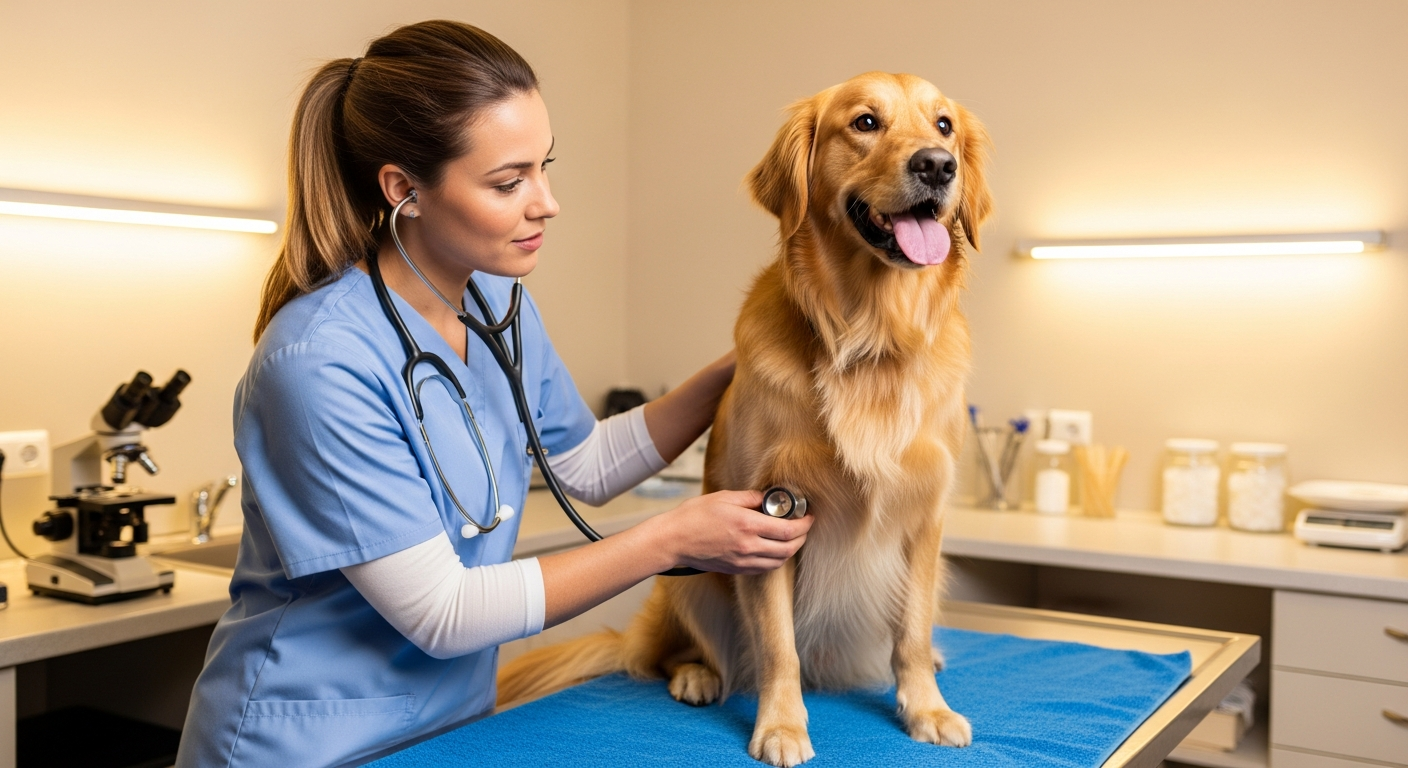


Fascia is incredibly important to bodily well-being. Supporting this vital network of connective tissue in yourself, your pets, and your animal patients can improve overall health.
Until about 20 years ago, the fascia the network of connective tissue in our bodies and those of our animal patients was disregarded for its true beauty and intelligence. Now, however, the fascia has been revealed as a brilliant living sensory fabric that covers and connects every aspect of the body: muscles, bones, nerves and organs. Fascia is the skin of the bodys cells. It connects trillions of cells, creating mobility, stability, and communication between all cells in the body. It is constantly adapting to environmental stresses and changing to meet the bodys structural demands. Nutrients travel through this matrix to the cells and waste products from the cells are removed and transported through the lymph system to be excreted. This article looks at the fascias crucial role in the body, what can go wrong, and how to remedy it.
THE CINDERELLA TISSUE IS RECOGNIZED AND HONORED
Andrew Taylor Still (1828-1917), physician, surgeon, and the founder of osteopathy, noted that the fascia covers, permeates, divides and subdivides every portion of the body. He further declared that healthy functioning fascia supports life, where the failure of fascia to function properly leads to death.
Around a century later, at the Fourth International Fascia Research Congress, held near Washington, DC in September 2015, two definitions of fascia were proposed: it was called both a fascia and the fascial system.
- A fascia is a sheath, a sheet, or any other dissectible aggregations of connective tissue that forms beneath the skin to attach, enclose, and separate muscles and other internal organs.
- The fascial system consists of the three dimensional continuum of soft, collagen- containing, loose and dense fibrous connective tissues that permeate the body, providing an environment that enables all body systems to operate in an integrated manner.
The first definition is morphological/anatomical, while the second is functional.1
Fibroblasts are the predominant cell population of the fascia tissue. Their primary role is to respond to stimuli. In doing so, they maintain the structural integrity and organization of the tissue. Fibroblasts are involved in mechanotransduction, and in secreting precursors of the extracellular matrix.
Mechanotransduction refers to the biological phenomenon wherein mechanical stresses applied to cells are translated into chemical signals that elicit adaptive responses, such as vasodilation of blood vessels, interpreting sound/hearing, postural balance, sensation of joint position, muscle contraction, and touch.2
Simply put, through our lifestyle choices we are communicating to our cells what is happening on the outside so they know how to respond to ensure our survival. How awesome is that!
WHAT DAMAGES FASCIA?
Scar formation, whether from injuries, chronic inflammation, or previous surgical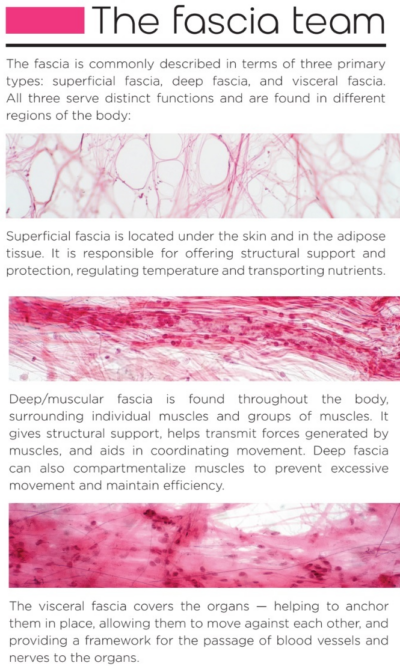 procedures, creates impeded flow through the fascia and lymphatics. The scar grips and spirals in, creating adhesions that create stability in the tissue. Wherever there is contracture, there is an equal and opposite ballooning out to compensate for the structural imbalance.
Over time, gravity compresses the fascia, causing the body to spiral downward and inward. If people are not actively focusing on their breath (diaphragmatic breathing), posture and healthy lifestyle (diet and exercise), they will get shorter and wider over time. Their shoulders roll forward, their upper body collapses into the lower body, and they breathe more from their chest muscles than the diaphragm. The fascia begins to compress, spiraling inward and downward, gripping onto whatever it can in an attempt to continue supporting the bodys posture and movement. The resulting adhesions hold the body out of natural alignment and further restrict flow through the fascia and lymph system.
Sitting for extended periods of time i.e. lack of movement and exercise is a problem of epic importance. The lymphatics (which are housed in the fascia) do not have a pump to move lymph the way the heart moves blood. The lymph system relies on movement and muscular contraction to pump waste products. As lymph becomes stagnate, toxins build up, leading to inflammation and disease.
OTHER FACTORS CONTRIBUTING TO FASCIA COMPRESSION
The Standard American Diet (S.A.D.) (which is no longer unique to Americans and exists worldwide) contributes to fascia dysfunction. Processed food diet, excess sugar, and nutrient depletion, as well as toxin overload, chronic stress, high sympathetic tone, sleep deprivation, poor posture (slumped in front of a computer or TV screen), shallow chest breathing (instead of diaphragmatic breathing), injuries, fear, and stress all contribute to a growing problem. I recently traveled through Europe and found processed junk food everywhere. All these factors cause the fascia to spiral down, creating adhesions in an attempt to stabilize the body. The adhesions also block normal blood flow to the cells, resulting in decreased oxygen and nutrient flow. Cell detoxification is also compromised.
The goal is to live a long and healthy life, and the key is to keep the fascia healthy and functioning so cells are in alignment and functioning at their highest potential.
THE PATHWAY TO THRIVING AND LONGEVITY
- Choose to live and behave in a way that supports health. This is truly about deciding what your lifestyle will look like, no excuses, just results. Own it! Your pets have no choice in the matter, since they depend on you to make good lifestyle choices that will determine their health and longevity. So think about them as well.
- Eat an appropriate diet along with essential nutrients. Feed your pets well too, and encourage your clients to do the same. For dogs and cats, this is a balanced raw diet (meat, fat, bone, and organ meat). Beware of diets that are complete and balanced since most have added synthetic vitamins and minerals!
- Reduce toxin exposure from food, water, your environment, EMF and even your negative thoughts yes, you might have some stinkin thinkin that needs to be reprogrammed!
- Move! Regular movement (exercise, high intensity movement, dance, etc.) is critically important for lymphatic and fascial health.
- Practice diaphragmatic breathing! This involves deep belly breaths that push the abdomen out with inhalation and brings it in and up on exhalation. Proper diaphragmatic breathing acts like a furnace, keeping proper warmth in the abdomen.
- Become educated. Your clients can learn more about diet, lifestyle, detoxification, and mitochondrial health by visiting drmarlenesiegel.com and clicking on The Empowered Pet Parent Course. Theres also a training course for veterinarians, about how to incorporate alternative medicine into your practice see Transforming Vet Medicine.
FASCIA DECOMPRESSION BRINGING CELLS BACK INTO PROPER ALIGNMENT
- Enroll in programs that teach how to create/recreate space by applying pressure (with hands or blocks) to melt the adhesions holding tissues out of alignment. Time and pressure increase heat, melt adhesions, and improve blood flow into the area. Visit Block Therapy to learn more.
- Inflate the space with proper diaphragmatic breathing. Proper breathing moves the diaphragm up and down and massages the abdominal organs. When we are not practicing diaphragmatic breathing, the diaphragm muscle gets weak and the weight of everything above causes us to collapse in and slump forward, leading to displacement of internal organs and tissues.
- The evidence is a ballooning belly! The muscles of the upper chest, the secondary breathing muscles, take over and do most of the breathing work. The result is shallow breathing and less than optimum oxygenation of the lungs which then leads to decreased oxygen intake for the cells. Proper diaphragmatic breathing can supply up to six times more oxygen to the body/cells. Improper breath occurs in pets as well.
- Shift into parasympathetic (out of sympathetic). Pain, fear and stress cause us to reactively hold our breath. Traumatic events and repeated traumas cause us to freeze and keep us in high sympathetic tone. Here are a few of my favorite activities to help shift into parasympathetic: entrain to proper frequency (PEMF), breath work, meditation, EFT (emotional freedom technique), and hyperbaric oxygen therapy. Find the ones that work for you and have your pet nearby as they will entrain to the frequencies and your energy.
Pull the cells back from where they have migrated and into proper alignment by using awareness, diaphragmatic breathing and Block Therapy/Fluid Isometrics to release adhesions, improve breathing, improve blood and oxygen delivery, maintain the extra space and correct the tissue alignment.
Problems in Our Animal Patients
Over my past 20 years as a veterinarian, I have observed an alarming increase in degenerative disc disease in my animal patients. Radiographs document the narrowing of vertebrae in animals as young as two years of age. This narrowing of disc spaces is caused by the paravertebral muscles contracting in an attempt to create stability, but it also restricts flow and results in a lack of proper circulation to the organs and limbs. It is my belief that the dramatic increase of cruciate injuries in pets reflects directly on a lack of nourishment and waste removal to the joints, due to the restricted flow of energy and cellular nutrition from the spinal column.
Become educated and empowered! The Fascia Decompression For Your Fur Family Course teaches you how to improve an animals diaphragmatic breathing. For details, go to drmarlenesiegel.com and click on Fascia Decompression For Your Fur Family.