Studies show that adaptogenic herbs can support adrenal health by helping regulate a pet’s response to stress, balance hormone levels, and improve resilience. These herbs are particularly beneficial for dogs and cats with adrenal dysfunction, such as Cushing’s or Addison’s disease.
Adrenal health is crucial for maintaining homeostasis in dogs and cats. The adrenal glands play a significant role in regulating metabolism, immune function, and stress response. Conditions such as Cushing’s disease (hyperadrenocorticism) and Addison’s disease (hypoadrenocorticism) can severely impact the well-being of pets, necessitating an integrative approach to treatment. One of the most effective ways to integratively support adrenal function is through adaptogenic herbs. Adaptogens are a class of natural substances that help the body adapt to stress, balance hormonal function, and enhance overall vitality. Traditional Chinese Veterinary Medicine (TCVM) and Ayurveda have long utilized adaptogens to regulate adrenal function, reduce inflammation, and restore balance in the body. This article will explore the best adaptogenic herbs for adrenal health, their mechanisms of action, and how integrative veterinarians can incorporate them into treatment plans for dogs and cats.
What are adaptogenic herbs?
The term “adaptogenic” refers to a natural substance (usually an herb or mushroom) that helps the body adapt to stress and maintain homeostasis. Adaptogens support the adrenal glands, regulate hormones like cortisol, and improve resilience to physical, emotional, and environmental stressors. Veterinary case studies have demonstrated that dogs and cats receiving adaptogenic herbal blends for adrenal imbalances show improved energy levels, reduced symptoms of hormonal disorders, and improved immune function.1
Key characteristics of adaptogens
Stress regulation – Adaptogens help balance the body’s stress response, preventing overreaction or exhaustion. Hormonal balance – They support endocrine functions, including adrenal health, by regulating cortisol and other hormones. Energy and vitality – They enhance stamina, focus, and energy without overstimulating (unlike caffeine or stimulants). Immune support – Many adaptogens strengthen the immune system, reducing the impact of chronic stress. Non-specific action – Adaptogens work across multiple body systems rather than targeting a single function. The adrenal glands are located above the Kidneys and produce essential hormones like cortisol, aldosterone, and adrenaline. When these glands become overactive or underactive, hormonal imbalances occur, leading to significant health issues, such as Cushing’s disease and Addison’s disease.
-
Cushing’s disease (hyperadrenocorticism)2-4
Disease characteristics
- Excess cortisol production by the adrenal glands (no matter the origin).
- Common in middle-aged and older dogs.
- Symptoms include excessive thirst and urination, panting, hair loss, muscle wasting, potbelly appearance.
TCVM perspective on Cushing’s disease
Cushing’s disease is viewed as an imbalance of Yin and Yang, Kidney Qi Deficiency, and excess internal heat. Unlike Western medicine, which primarily focuses on the endocrine disorder and excess cortisol production, TCVM considers Cushing’s a systemic imbalance affecting multiple organ systems, particularly the Kidney, Liver, and Spleen. TCVM pathophysiology of Cushing’s disease TCVM classifies Cushing’s disease into different syndromes based on the presenting symptoms:
- Kidney Yin Deficiency with heat
- Common symptoms: Excess thirst, panting, restlessness, heat intolerance, dry skin, hair loss, and red tongue.
- TCVM interpretation: The Kidneys govern water metabolism, and a deficiency in Kidney Yin leads to an inability to cool the body, resulting in internal heat.
- TCVM approach: Nourish Kidney Yin, clear heat, and restore balance.
- Spleen Qi Deficiency and dampness
- Common symptoms: Lethargy, muscle wasting, weight gain, bloating, and poor digestion.
- TCVM interpretation: The Spleen transforms and transports nutrients, and when deficient, leads to dampness accumulation, causing metabolic slowdowns.
- TCVM approach: Strengthen the Spleen, resolve dampness, and support digestion.
- Liver Qi stagnation with heat
- Common symptoms: Increased irritability, anxiety, skin inflammation, red tongue with a yellow coating.
- TCVM interpretation: The Liver regulates Qi flow, and stress can cause stagnation, leading to heat generation and inflammation.
- TCVM approach: Soothe the Liver, regulate Qi, and clear excess heat.
-
Addison’s disease (hypoadrenocorticism)5.6
Disease characteristics
- Insufficient production of adrenal hormones.
- More common in young to middle-aged dogs (rare in cats).
- Symptoms include lethargy, vomiting, diarrhea, weakness, low blood pressure, and weight loss.
TCVM perspective on Addison’s disease
Addison’s disease (hypoadrenocorticism) is viewed as a Kidney Yang Deficiency, sometimes accompanied by Qi and Blood Deficiency or Spleen Qi Deficiency. The Kidneys are considered the root of Yuan Qi (Original Qi) and govern the adrenal function in TCVM. When there is a deficiency in Kidney Yang, the body’s ability to generate warmth, energy, and proper hormonal balance is compromised. TCVM patterns of Addison’s disease
- Kidney Yang Deficiency
- Symptoms: Fatigue, cold intolerance, weak pulse, poor appetite, depression, weight loss, and low energy.
- TCVM interpretation: Kidney Yang provides the body with warmth and energy. A deficiency leads to poor hormone production and circulation, similar to low cortisol levels.
- TCVM treatment approach: Warm and tonify Kidney Yang, strengthen Qi, and improve adrenal resilience.
- Qi Deficiency
- Symptoms: Poor digestion, diarrhea, bloating, weakness, and weight loss.
- TCVM interpretation: The Spleen governs digestion and Qi production — a deficiency results in fatigue and poor nutrient absorption, further worsening adrenal insufficiency.
- TCVM treatment approach: Strengthen Spleen Qi to enhance digestion and support adrenal recovery.
- Qi and Blood Deficiency
- Symptoms: Weakness, dizziness, pale gums, hair loss, and low stamina.
- TCVM interpretation: Chronic illness or stress depletes Qi (vital energy) and Blood, weakening adrenal function.
- TCVM treatment approach: Tonify Qi and Blood, improve circulation, and restore vitality.
Best Western adaptogenic herbs for adrenal health in dogs and cats
Ashwagandha (Withania somnifera)
- Calms the nervous system and regulates cortisol levels
- Supports immune function
- Aids in reducing anxiety and fatigue
- Research suggests Ashwagandha has a balancing effect on the hypothalamic-pituitary-adrenal (HPA) axis, regulating cortisol production. Studies on rodents indicate it helps modulate stress responses and adrenal function.7,8
Rhodiola (Rhodiola rosea)
- Enhances mental and physical endurance
- Supports the nervous system
- Helps balance adrenal function
- Clinical trials show Rhodiola’s ability to enhance stress resistance and normalize cortisol levels. It has been used in veterinary practice to manage adrenal fatigue and support nervous system function in pets.9
Holy Basil (Ocimum sanctum, Tulsi)
- Reduces stress and anxiety and promotes relaxation
- Supports cortisol regulation
- Has anti-inflammatory and antioxidant properties.10, 11
Eleuthero (Eleutherococcus senticosus, Siberian Ginseng)
- Boosts energy and endurance
- Supports adrenal and immune health
- Helps the body adapt to stress.12,13
Best Chinese adaptogenic herbs for adrenal health in dogs and cats
- Rehmannia (Rehmannia glutinosa, Shu Di Huang)
Rehmannia helps pets with Addison’s disease (deficient adrenal function). It supports adrenal and Kidney health and is one of the most potent Kidney-adrenal tonics in TCVM. It nourishes Yin, cools internal heat, and helps balance hormones.
- Helps balance cortisol production
- Nourishes Yin energy and reduces inflammation
- Supports adrenal hormone production, nourishes Kidney Yin and reduces oxidative stress.
- Rehmannia is a foundational herb in TCVM, often used to strengthen the Kidneys and replenish adrenal function. Since the Kidneys and adrenals are closely linked in TCVM, Rehmannia helps restore cortisol balance and prevent adrenal fatigue.
- Research supports its role in nourishing the Kidneys and regulating endocrine functions14
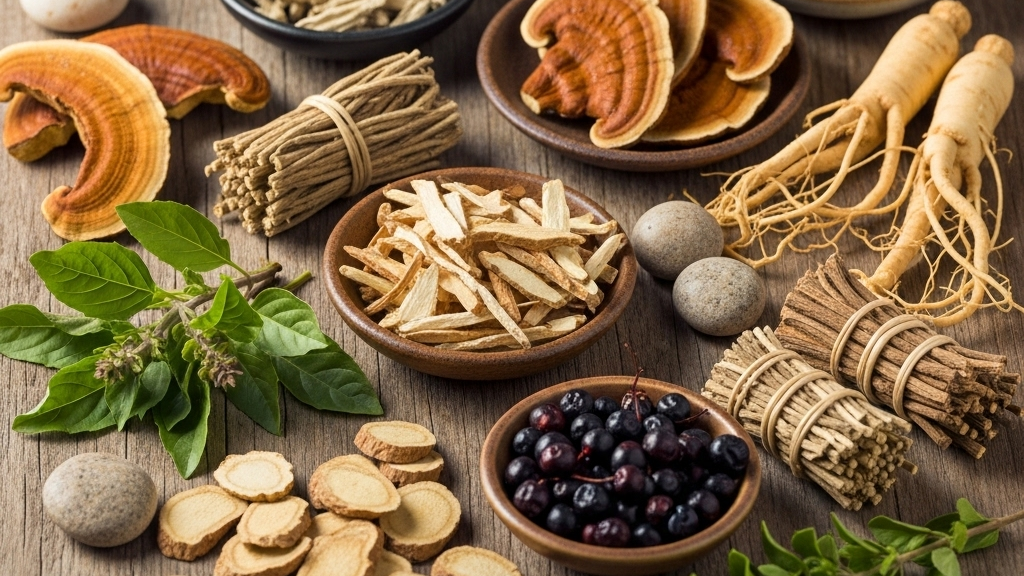
Astragalus (Astragalus membranaceus, Huang Qi) Astragalus enhances immune function and supports adrenal recovery from chronic stress. It helps boost energy and stamina, especially in older pets, and strengthens adrenal recovery from stress.
- Supports overall vitality and energy
- Boosts immune function and enhances adrenal recovery in stressed animals
- Increases stress resilience, enhances mitochondrial function, and modulates cortisol levels
- Animal studies indicate Astragalus supports immune function and adrenal recovery by enhancing cellular resilience to stressors.15
Ginseng (Panax ginseng, Ren Shen) This potent adaptogen enhances energy, focus, and stress resistance, and boosts immune function. Supports adrenal function, promotes longevity, and regulates cortisol levels.16-19
- Enhances stamina and longevity
- Supports adrenal function.
Schisandra (Schisandra chinensis, Wu Wei Zi) Known as the “five-flavored berry,” Schisandra harmonizes multiple organs. It supports liver detoxification and adrenal function, as well as nervous system function.
- Improves stress resistance
- Enhances mental clarity and endurance
- Reduces stress, detoxifies the liver, and supports adrenal function.
- Acts as an HPA axis regulator, balances cortisol levels, and protects against oxidative stress.20
Cordyceps (Cordyceps sinensis, Dong Chong Xia Cao) Cordyceps enhances stamina, adrenal resilience, immune function, and vitality. It helps pets recover from chronic fatigue or stress-related exhaustion, and boosts energy. It supports Kidney and Lung Qi, which is essential for adrenal balance.
- Supports Kidney and lung function
- Helps balance cortisol levels
- Enhances energy levels, combats fatigue. and supports adrenal function
- Supports ATP production, improves lung and Kidney function, and regulates adrenal output
- Research in both humans and animals highlight Cordyceps’ adaptogenic properties, showing improved energy metabolism, stress resistance, and enhanced adrenal function.21,22
Licorice root (Glycyrrhiza uralensis, Gan Cao) Licorice root is beneficial for pets with Addison’s disease (low cortisol). It helps regulate cortisol levels and adrenal function. Caution: Avoid in pets with high blood pressure or heart disease.
- Supports adrenal function
- Contains glycyrrhizin, which prolongs cortisol action, making it highly beneficial for pets with adrenal insufficiency
- Inhibits cortisol breakdown, reduces inflammation, and supports adrenal function.
- Studies confirm that licorice root prolongs cortisol half-life by inhibiting its breakdown, making it beneficial for the treatment of Addison’s disease.23,24
Best Chinese herbal formulas with adaptogenic herbs for adrenal health in dogs and cats TCVM tends to use herbal formulas rather than individual herbs. These formulas can help manage Cushing’s and Addison’s disease in pets. TCVM herbal formula approach to Cushing’s in pets
- Rehmannia Eight Formula (Zhi Bai Di Huang Wan): Best for Cushing’s disease (excess cortisol) Kidney Yin Deficiency with heat, seen as excessive thirst, panting, or heat intolerance. Key herbs include:
- Rehmannia (Shu Di Huang) – nourishes Kidney Yin, reduces heat
- Cornus (Shan Zhu Yu) – supports Kidney and Liver function
- Dioscorea (Shan Yao) – strengthens Spleen and digestion
- Poria (Fu Ling) – resolves dampness
- Alisma (Ze Xie) – clears Kidney heat
- Moutan Bark (Mu Dan Pi) – cools excess heat
- Anemarrhena (Zhi Mu) and Phellodendron (Huang Bai) – strong heat-clearing herbs.
This formula nourishes Yin, clears excess heat, and regulates fluid balance, making it ideal for Cushing’s disease cases with heat signs. 

- Bupleurum and Rehmannia Formula (Chai Hu Shu Gan San): Best for pets with Liver Qi Stagnation with heat, seen as chronic stress, anxiety, adrenal exhaustion. Key herbs include:
- Bupleurum (Chai Hu) – regulates Liver Qi, reduces stress
- Rehmannia (Shu Di Huang) – supports Kidney and Yin balance
- Licorice (Gan Cao) – modulates cortisol regulation
- White Peony (Bai Shao) – supports Blood and relaxation
- Poria (Fu Ling) – resolves dampness and calms the mind.
This formula helps soothe Liver Qi stagnation, which can lead to stress-induced cortisol imbalances. TCVM herbal formula approach to Addison’s in pets
- Rehmannia Six Formula (Liu Wei Di Huang Wan): Best for Kidney Yang Deficiency with Qi Deficiency. Key herbs include:
- Rehmannia (Shu Di Huang) – tonifies Kidney and Yin
- Cornus (Shan Zhu Yu) – strengthens Kidney and Liver function
- Dioscorea (Shan Yao) – strengthens digestion and Qi production
- Poria (Fu Ling) – reduces dampness, aids digestion
- Alisma (Ze Xie) – regulates water metabolism
- Moutan Bark (Mu Dan Pi) – clears heat and supports Yin.
This formula nourishes Yin and strengthens the Kidney, essential in adrenal insufficiency.
- Kidney Yang Boosting Formula (Jin Gui Shen Qi Wan): Best for cold intolerance, lethargy, low energy. Key herbs include:
- Rehmannia (Shu Di Huang) – nourishes Kidney Yin
- Cinnamon Bark (Rou Gui) – warms Kidney Yang
- Aconite (Fu Zi) – strongly warms Yang
- Poria (Fu Ling) – aids digestion
- Alisma (Ze Xie) – regulates water metabolism
This formula tonifies Kidney Yang, helping restore warmth and energy to the body.
- Bupleurum and Astragalus Formula (Bu Zhong Yi Qi Tang): Best for Spleen Qi Deficiency with low adrenal function. Key herbs include:
- Astragalus (Huang Qi) – strengthens immune function and energy levels
- Bupleurum (Chai Hu) – regulates Qi
- Ginseng (Ren Shen) – tonifies Qi and boosts adrenal function
- Licorice Root (Gan Cao) – supports cortisol regulation
This formula enhances digestion, strengthens the immune system, and supports adrenal recovery. Conclusion Western and Chinese adaptogenic herbs provide a natural approach to adrenal health in dogs and cats. By balancing cortisol levels, reducing oxidative stress, and enhancing resilience, these herbs can be complementary to conventional treatments. Adaptogenic herbs can support adrenal health by helping regulate the body’s response to stress, balance hormone levels, and improve resilience. These herbs are particularly beneficial for pets with adrenal dysfunction, such as Cushing’s disease (excess cortisol production), a manifestation of Kidney Yin Deficiency, Liver Qi stagnation, and internal heat accumulation; or Addison’s disease (insufficient cortisol production), a manifestation of Kidney Yang Deficiency, Qi Deficiency, and possible Blood Deficiency. Scientific studies support the efficacy of adaptogens, and clinical evidence in veterinary medicine suggests significant benefits for pets with adrenal disorders. Veterinarians can integrate these herbs into treatment plans. Using herbal formulas and dietary modifications, integrative veterinarians can restore balance and strengthen the body’s resilience. Combining TCVM with Western veterinary treatments can provide a comprehensive approach to managing adrenal issues in pets. _______________________________________________________________ 1Sulaiman MK, Lakshmanan J. Systemic and Anticancer Potential of Adaptogenic Constituents Isolated from Traditional Herbs – A Mini-Review. Anticancer Agents Med Chem. 2022 Aug 4;22(16):2811-2821. doi: 10.2174/1871520622666220408091610. PMID: 35400325. 2Bennaim M, Shiel RE, Mooney CT. Diagnosis of spontaneous hyperadrenocorticism in dogs. Part 1: Pathophysiology, aetiology, clinical and clinicopathological features. Vet J. 2019 Oct;252:105342. doi: 10.1016/j.tvjl.2019.105342. Epub 2019 Jul 23. PMID: 31554593. 3Bennaim M, Shiel RE, Mooney CT. Diagnosis of spontaneous hyperadrenocorticism in dogs. Part 2: Adrenal function testing and differentiating tests. Vet J. 2019 Oct;252:105343. doi: 10.1016/j.tvjl.2019.105343. Epub 2019 Jul 27. PMID: 31554584. 4Sanders K, Kooistra HS, Galac S. Treating canine Cushing’s syndrome: Current options and future prospects. Vet J. 2018 Nov;241:42-51. doi: 10.1016/j.tvjl.2018.09.014. Epub 2018 Sep 27. PMID: 30340659. 5Kerr MG. Addison’s disease in the dog. Vet Rec. 1989 Apr 8;124(14):379. doi: 10.1136/vr.124.14.379-b. PMID: 2718340. 6Chiaramonte D, Greco DS. Feline adrenal disorders. Clin Tech Small Anim Pract. 2007 Feb;22(1):26-31. doi: 10.1053/j.ctsap.2007.02.004. PMID: 17542194. 7Bharani KK, Devarasetti AK, Carey L, Khurana A, Kollipaka R, Hanuman DDV, Chetla VS, Banothu AK. Effects of Ashwagandha (Withania somnifera) root extract on aging-related changes in healthy geriatric dogs: A randomized, double-blinded placebo-controlled study. Vet Med Sci. 2024 Sep;10(5):e1556. doi: 10.1002/vms3.1556. PMID: 39078383; PMCID: PMC11288135. 8Salve J, Pate S, Debnath K, Langade D. Adaptogenic and Anxiolytic Effects of Ashwagandha Root Extract in Healthy Adults: A Double-blind, Randomized, Placebo-controlled Clinical Study. Cureus. 2019 Dec 25;11(12):e6466. doi: 10.7759/cureus.6466. PMID: 32021735; PMCID: PMC6979308. 9Zhang Z, Liu J, Shang X, Yang J, Chu J, Wang Z, Yao Z, Ma H, Li Q, Wang Y. [The effect of Rhodiola capsules on oxygen consumption of myocardium and coronary artery blood flow in dogs]. Zhongguo Zhong Yao Za Zhi. 1998 Feb;23(2):104-6, inside back cover. Chinese. PMID: 11596257. 10Singh S, Majumdar DK. Evaluation of antiinflammatory activity of fatty acids of Ocimum sanctum fixed oil. Indian J Exp Biol. 1997 Apr;35(4):380-3. PMID: 9315239. 11Singh S, Taneja M, Majumdar DK. Biological activities of Ocimum sanctum L. fixed oil—an overview. Indian J Exp Biol. 2007 May;45(5):403-12. PMID: 17569280. 12Esmaealzadeh N, Iranpanah A, Sarris J, Rahimi R. A literature review of the studies concerning selected plant-derived adaptogens and their general function in body with a focus on animal studies. Phytomedicine. 2022 Oct;105:154354. doi: 10.1016/j.phymed.2022.154354. Epub 2022 Jul 21. PMID: 35932607. 13Chen TS, Liou SY, Chang YL. Antioxidant evaluation of three adaptogen extracts. Am J Chin Med. 2008;36(6):1209-17. doi: 10.1142/S0192415X08006533. PMID: 19051347. 14Zhang RX, Li MX, Jia ZP. Rehmannia glutinosa: review of botany, chemistry and pharmacology. J Ethnopharmacol. 2008 May 8;117(2):199-214. doi: 10.1016/j.jep.2008.02.018. Epub 2008 Mar 10. PMID: 18407446. 15Sheik A, Kim K, Varaprasad GL, Lee H, Kim S, Kim E, Shin JY, Oh SY, Huh YS. The anti-cancerous activity of adaptogenic herb Astragalus membranaceus. Phytomedicine. 2021 Oct;91:153698. doi: 10.1016/j.phymed.2021.153698. Epub 2021 Aug 5. PMID: 34479785. 16Nocerino E, Amato M, Izzo AA. The aphrodisiac and adaptogenic properties of ginseng. Fitoterapia. 2000 Aug;71 Suppl 1:S1-5. doi: 10.1016/s0367-326x(00)00170-2. PMID: 10930706. 17Liao LY, He YF, Li L, Meng H, Dong YM, Yi F, Xiao PG. A preliminary review of studies on adaptogens: comparison of their bioactivity in TCM with that of ginseng-like herbs used worldwide. Chin Med. 2018 Nov 16;13:57. doi: 10.1186/s13020-018-0214-9. PMID: 30479654; PMCID: PMC6240259. 18Chan SW. Panax ginseng, Rhodiola rosea and Schisandra chinensis. Int J Food Sci Nutr. 2012 Mar;63 Suppl 1:75-81. doi: 10.3109/09637486.2011.627840. Epub 2011 Nov 1. PMID: 22039930. 19Qi HY, Li L, Ma H. Cellular stress response mechanisms as therapeutic targets of ginsenosides. Med Res Rev. 2018 Mar;38(2):625-654. doi: 10.1002/med.21450. Epub 2017 Jun 6. PMID: 28586505. 20Rybnikář M, Šmejkal K, Žemlička M. Schisandra chinensis and its phytotherapeutical applications. Ceska Slov Farm. 2019 Summer;68(3):95-118. English. PMID: 31431019. 21Jędrejko KJ, Lazur J, Muszyńska B. Cordyceps militaris: An Overview of Its Chemical Constituents in Relation to Biological Activity. Foods. 2021 Oct 30;10(11):2634. doi: 10.3390/foods10112634. PMID: 34828915; PMCID: PMC8622900. 22Shashidhar MG, Giridhar P, Udaya Sankar K, Manohar B. Bioactive principles from Cordyceps sinensis: A potent food supplement – A review. J Funct Foods. 2013 Jul;5(3):1013-1030. doi: 10.1016/j.jff.2013.04.018. Epub 2013 May 24. PMID: 32288795; PMCID: PMC7104994. 23Jarrett RH, Norman EJ, Squires RA. Liquorice and canine Addison’s disease. N Z Vet J. 2005 Jun;53(3):214. doi: 10.1080/00480169.2005.36508. PMID: 16012593. 24Methlie P, Husebye EE, Hustad S, Lien EA, Løvås K. Grapefruit juice and licorice increase cortisol availability in patients with Addison’s disease. Eur J Endocrinol. 2011 Nov;165(5):761-9. doi: 10.1530/EJE-11-0518. Epub 2011 Sep 6. PMID: 21896619.