The way we understand and train horses is evolving rapidly. While traditional horsemanship remains the foundation of successful equine management, advances in biomechanics and movement-tracking technology are giving owners, trainers, and veterinarians unprecedented insight into how horses move. These tools can help identify subtle changes in performance, monitor conditioning progress, and detect potential issues before they become significant problems.
As technology becomes more accessible, biomechanics and movement analysis are transforming horse training from a largely observational practice into one supported by measurable data.
What Equine Biomechanics Means in Practical Terms
Equine biomechanics is the study of how a horse’s body moves. It examines the interaction of muscles, joints, tendons, ligaments, and bones during movement, helping us understand how forces are distributed throughout the body.
In practical terms, biomechanics answers questions such as:
- Is the horse moving symmetrically?
- Is one limb carrying more weight than another?
- How efficiently is the horse using its body?
- Are there subtle movement compensations that may indicate discomfort?
By understanding these movement patterns, trainers can make more informed decisions about conditioning programs, workload management, and performance goals.
Why Movement Quality Matters More Than Intensity
Many riders focus on the amount of work a horse performs, but movement quality is often a more important indicator of long-term soundness and success.
A horse that performs demanding exercises with poor posture, imbalance, or inefficient movement patterns may place excessive stress on joints and soft tissues. Over time, these compensations can contribute to injury and reduced performance.
Quality movement emphasizes:
- Balance and coordination
- Straightness and symmetry
- Proper engagement of the hindquarters
- Consistent rhythm and cadence
- Efficient use of energy
When movement quality improves, performance often follows naturally while reducing unnecessary strain on the body.
Emerging Technologies in Equine Movement Analysis
Technological innovation is making sophisticated biomechanical analysis available beyond specialized research facilities.
Wearable Sensors
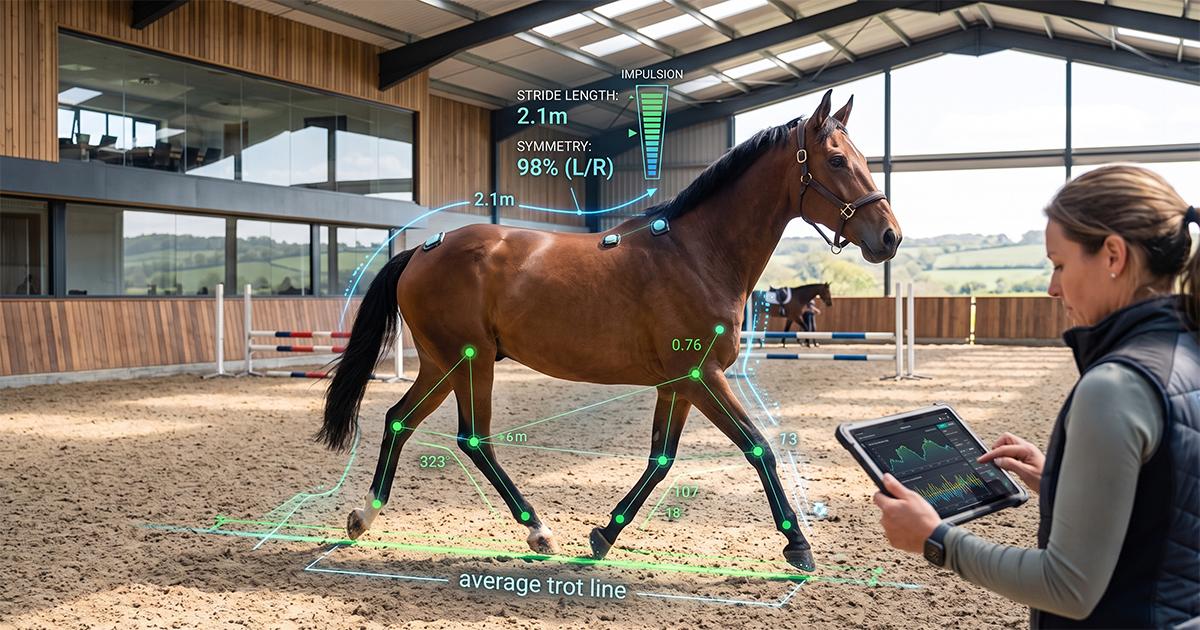
Wearable sensors are among the fastest-growing tools in equine performance monitoring. These lightweight devices attach to various parts of the horse’s body, including the head, saddle, girth, or limbs.
They can measure:
- Stride length
- Acceleration and deceleration
- Symmetry between left and right sides
- Movement consistency
- Training workload
Because data can be collected during normal riding sessions, trainers gain valuable insights without disrupting the horse’s routine.
Motion Capture Apps
Modern smartphones and tablets now offer motion-analysis applications capable of recording and evaluating movement patterns through video.
These systems allow trainers to:
- Compare movement over time
- Assess posture and alignment
- Evaluate training progress
- Review performance frame by frame
Video-based analysis can help identify subtle changes that may be difficult to detect during live observation.
AI Gait Analysis Tools
Artificial intelligence is becoming increasingly important in equine health and performance monitoring.
AI-powered gait analysis systems can evaluate thousands of movement data points and identify patterns associated with:
- Asymmetrical movement
- Early-stage lameness
- Performance inefficiencies
- Changes in movement quality
Some systems can detect abnormalities before they become obvious to the human eye, allowing for earlier intervention and management.
How Trainers Are Using Data to Improve Performance
Performance horses are often evaluated subjectively, relying on rider feel and trainer experience. While these skills remain invaluable, objective data provides another layer of information.
Trainers are using biomechanics data to:
- Track conditioning progress
- Optimize training intensity
- Monitor recovery after exercise
- Assess saddle fit impacts
- Evaluate the effectiveness of rehabilitation programs
- Fine-tune performance goals
By combining traditional observation with measurable metrics, training decisions can become more precise and individualized.
Benefits for Injury Prevention and Early Lameness Detection
One of the most promising applications of movement tracking is early detection.
Many injuries develop gradually as small movement compensations accumulate over time. Traditional observation may not detect these subtle changes until a horse becomes visibly lame.
Movement analysis technology can help identify:
- Minor asymmetries
- Changes in stride characteristics
- Altered weight distribution
- Progressive performance decline
- Early signs of discomfort
Detecting issues sooner may allow trainers and veterinarians to modify workload, investigate underlying causes, and potentially prevent more serious injuries.
Balancing Technology with Horsemanship Intuition
While technology offers valuable information, it should complement—not replace—good horsemanship.
Experienced trainers develop an understanding of each horse’s personality, attitude, behavior, and movement style. These observations provide context that technology alone cannot fully capture.
The most effective approach combines:
- Objective movement data
- Rider feedback
- Veterinary assessments
- Hands-on observation
- Knowledge of the individual horse
Technology works best when it enhances human decision-making rather than attempting to replace it.
Future Trends in Equine Performance Monitoring
The future of equine biomechanics is likely to become even more sophisticated and accessible.
Emerging developments may include:
- Real-time performance monitoring during rides
- Continuous health tracking through integrated wearable systems
- Advanced predictive injury-risk modeling
- AI-assisted training recommendations
- Remote collaboration between trainers and veterinarians
- Improved mobile applications for everyday horse owners
As these tools continue to evolve, they have the potential to improve horse welfare, optimize performance, and support more informed management decisions across all disciplines.
Final Thoughts
Biomechanics and movement tracking represent an exciting step forward in equine training and care. By providing objective insights into how horses move, these technologies can help trainers improve performance, monitor conditioning, and identify potential problems earlier than ever before.
However, the future of horse training is unlikely to be defined by technology alone. The most successful outcomes will come from combining innovative tools with the timeless skills of observation, experience, and thoughtful horsemanship. Together, data and intuition can create a more complete understanding of equine movement, supporting healthier and more successful horses for years to come.