

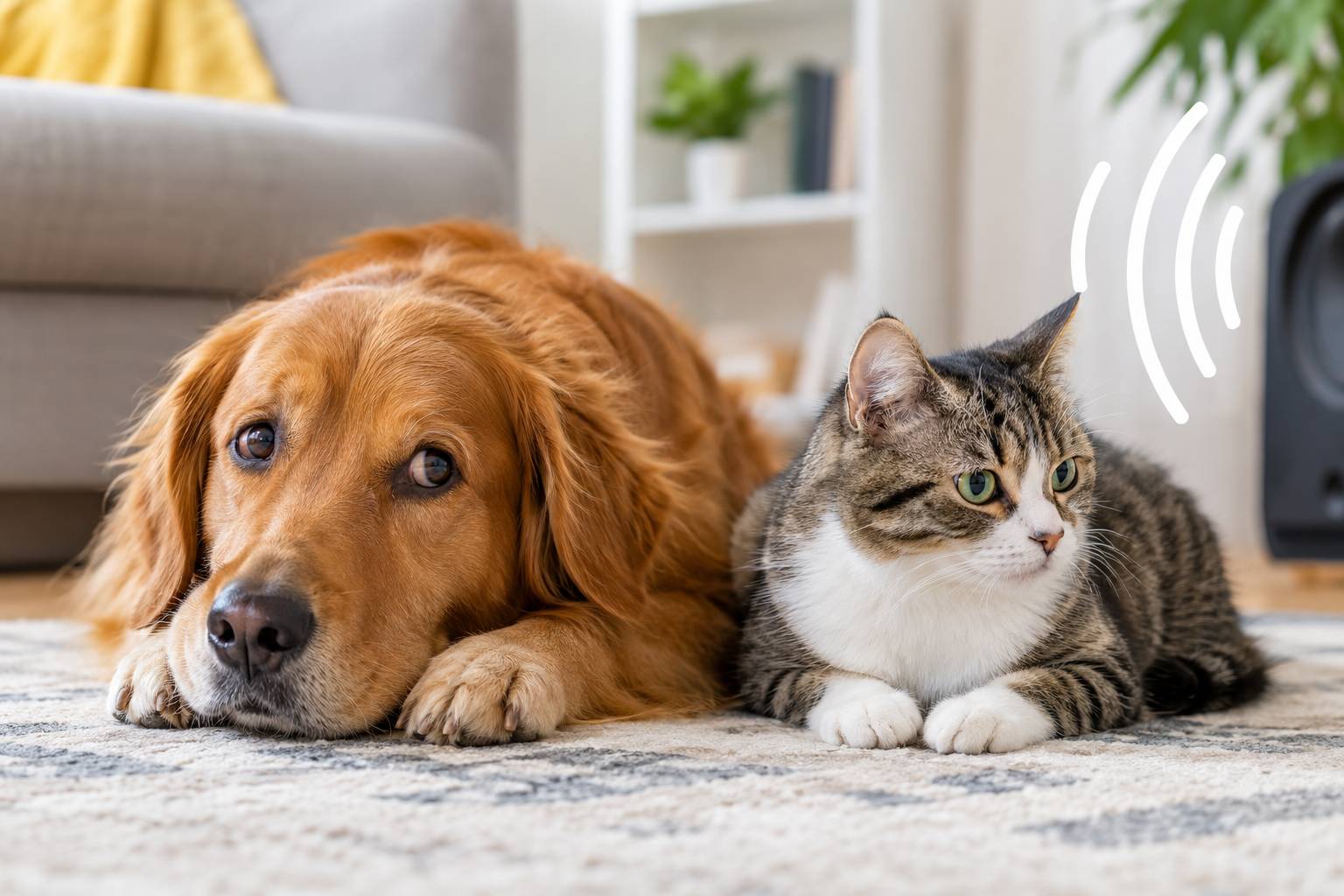
How Do Sounds Affect Your Dog or Cat?
Your dog may bark at a sound you barely notice. Your cat may suddenly leave the room when a device switches on. Maybe fireworks, thunderstorms, or a vacuum cleaner send your pet looking for somewhere to hide.
Sound can have a bigger effect on dogs and cats than many pet parents realize. Their hearing is more sensitive than ours, and they may respond to sounds, frequencies, and household noises that barely register with us.
TL;DR: The sounds around your home can influence how comfortable your dog or cat feels, particularly when certain noises are startling or stressful. Learning more about your pet’s sound environment can help you make thoughtful changes at home. If you want to explore the topic further, check out the “How Sounds Affect Your Dog or Cat” course.
Why do sounds affect dogs and cats differently?
We tend to judge noise from a human perspective. If a television, laptop, light fixture, or appliance seems quiet to us, we may assume our pets barely notice it.
That isn’t necessarily the case.
Dogs and cats can hear frequencies that humans don’t, meaning some sounds in the home may be noticeable to them even when we’re completely unaware of them. Animal Wellness Academy has previously highlighted electronic devices, fluorescent lights, motion detectors, and other household items as potential sources of sounds that some pets may react to.
Your pet’s reaction can also depend on the individual animal. One dog may sleep through a busy household while another becomes tense or unsettled by certain noises.
What sounds can make your pet uncomfortable?
Loud, sudden sounds are an obvious example. Fireworks, thunderstorms, construction, alarms, and vacuum cleaners can all be startling.
But volume isn’t the only part of the equation. Frequency matters, too.
A sound doesn’t have to be loud from our perspective to get your dog’s or cat’s attention. That’s why paying attention to your pet’s reactions can be more useful than simply deciding whether a noise seems loud to you.
Look for patterns. Does your dog leave the room when a particular appliance starts? Does your cat hide when the household becomes noisy? Does your pet seem more relaxed in a quieter part of the home?
Those observations can tell you something about their individual sound environment.
How can you create a calmer soundscape at home?
You don’t need to turn your home into a silent retreat.
Start with simple changes. Turn off electronics when you’re not using them. Consider changing harsh alerts and ringtones to softer sounds. Give your dog or cat access to a quiet area where they can move away from household activity when they need a break. These are among the practical soundscape suggestions highlighted by Animal Wellness Academy.
Think about where your pet spends most of their time, too. A cozy bed in a busy area may look comfortable, but a quieter location might be more appealing to an animal that is sensitive to sound.
The goal isn’t to eliminate every noise. It’s to give your pet some control over their surroundings.
Can music help calm a dog or cat?
Music is another area worth exploring.
Animal Wellness Academy’s previous coverage of animal sound environments discusses how certain tones, frequencies, and types of music may be more soothing for some dogs and cats. It also recommends keeping music at a comfortable volume rather than assuming that louder is better.
That doesn’t mean every pet will enjoy the same playlist.
Your dog may settle when soft music is playing, while your cat may prefer a quiet room. Watch your companion’s behavior and let their response guide you.
What can you learn about your pet’s response to sound?
Understanding sound sensitivity starts with noticing what your pet hears and how they respond.
The How Sounds Affect Your Dog or Cat course gives pet parents an opportunity to look more closely at the relationship between sound and their animals’ wellbeing. Rather than simply thinking about whether a noise is loud, you can start considering the broader soundscape your pet experiences every day.
That can change the way you look at ordinary things around your home, from electronic devices to music and the spaces where your pet rests.
For dog and cat parents who want to understand their companions a little better, it’s an interesting area to explore.
Take Our Course: “How Sounds Affect Your Dog or Cat”
Want to learn more about the sounds your dog or cat experiences every day?
Our How Sounds Affect Your Dog or Cat course can help you explore how sound may affect your pet and how you can create a more comfortable sound environment at home.
Frequently Asked Questions
Can dogs and cats hear sounds humans can’t?
Yes. Dogs and cats can detect some frequencies that fall outside the range of human hearing, so they may notice sounds that people don’t.
Can household electronics bother pets?
Some pets may react to sounds produced by household electronics and appliances. Devices such as fluorescent lights, motion detectors, and certain computers or televisions have been identified as potential sources of sounds pets may notice.
How can I make my home quieter for my pet?
Try turning off unused devices, choosing softer notification sounds, keeping music at a comfortable volume, and providing a quiet area where your pet can retreat from household activity.
Should I play music for my dog or cat?
You can experiment with calm, low-volume music and watch how your pet responds. Not every animal will react the same way, so your pet’s behavior is a useful guide.